
2026-10-15 Thu
Navratri celebrates the many manifestations of the Divine Feminine, or Shakti, representing the power that sustains the universe and triumphs over evil. On the fifth day, devotees worship Goddess Skandamata, the maternal form of Goddess Parvati and the mother of Lord Skanda, also known as Kartikeya. She embodies maternal love, compassion, protection, and divine strength.
Henceforth, we present gold Varaha of Devaraya I, Vijayanagara Empire (c. 1336–1646 CE). The empire was one of the most influential political powers in South Indian history. Founded in the fourteenth century, the empire became renowned for its military strength, administrative achievements, flourishing trade, and remarkable contributions to art, architecture, and temple culture. Its coinage provides valuable insights into the religious traditions, royal authority, and artistic sensibilities of the period.
Among the rulers of the Sangama dynasty, Devaraya I (c. 1406–1422 CE) played an important role in strengthening the Vijayanagara kingdom. His reign witnessed continued political and military engagement with neighbouring powers, particularly the Bahmani Sultanate. The gold coinage issued during this period reflects the prosperity and sophisticated minting traditions of the empire.
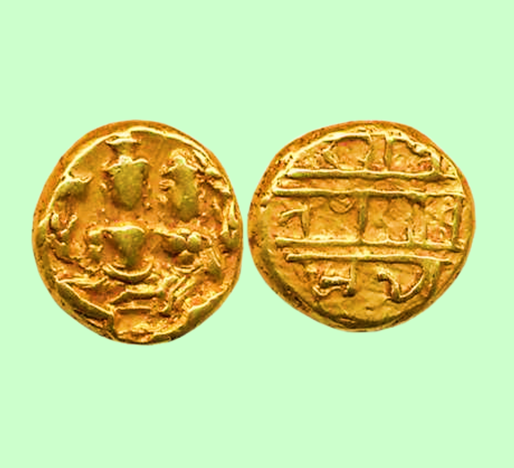
This gold Varaha, weighing 3.39 grams, is a striking example of Vijayanagara numismatic art, distinguished by its depiction of Lord Shiva seated with Goddess Parvati. The divine couple represents an important theme in Hindu religious iconography, symbolising the complementary aspects of divine power and the unity of Shiva and Shakti.
The Varaha was a prominent gold denomination associated with the Vijayanagara monetary system. Gold coins served as important instruments of high-value transactions, wealth accumulation, and regional and long-distance trade. Their compact format also encouraged the use of religious symbols and inscriptions to communicate identity and authority.
The obverse depicts Lord Shiva seated alongside Goddess Parvati. The representation of the divine couple highlights the significance of Shaivite traditions within the religious landscape of South India. Their presence on a gold coin also illustrates how sacred imagery found expression in objects associated with royal authority, commerce, and wealth.
The reverse bears a three-line legend in Devanagari script. Such legends are important features of medieval Indian coinage, offering clues to the linguistic and cultural traditions associated with a coin's production. The precise reading of this legend would help establish its full numismatic significance. This coin gives glimpses into the political history, religious traditions, and artistic heritage of the Vijayanagara Empire in a remarkable numismatic object.
-
Goddess Kali on a Nagapattinam Copper Stuiver Coin
2026-10-15 ThuIn the spirit of Navratri, a copper coin from Nagapattinam bearing the facing figure of Goddess K...
-
Celebrating Navratri through Numismatics: Gold Pagoda of the Kadambas of Hangal
2026-10-14 WedThe coinage of medieval Karnataka offers fascinating insights into the political authority, artis...
-
Kubera, God of Wealth, on a Rare Dramma of the Early Rashtrakutas
2026-10-14 WedThe coinage of medieval Maharashtra offers fascinating glimpses into the region’s political his...
-
Seated Divine Couple on a Copper Kasu of the Nayakas of Madurai
2026-10-13 TueOn the third day of Navaratri, we celebrate the divine feminine power, or Shakti, and pay tribute...
-
A Seated Goddess and a Lion on a Gold Fanam of the Hoysalas of Dwarasamudra
2026-10-13 TueThe Hoysalas were a prominent medieval South Indian dynasty that ruled large parts of present-day...