
2026-10-14 Wed
The coinage of medieval Karnataka offers fascinating insights into the political authority, artistic traditions, and cultural heritage of South India. Among its notable examples is a gold pagoda attributed to the Kadambas of Hangal, bearing the name of Shivachitta and distinguished by the striking depiction of a lion on its obverse.
The Kadambas of Hangal emerged as an important regional power in Karnataka during the medieval period. Originating around Hangal, they maintained connections with larger Deccan powers while exercising varying degrees of political independence. Their coinage forms a valuable part of the numismatic heritage of the region, reflecting the artistic conventions and monetary practices of their time.
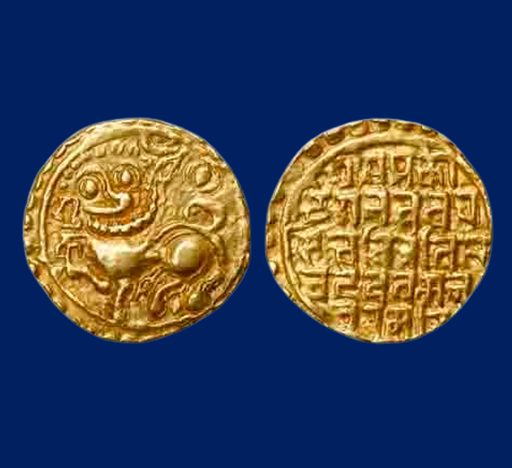
This shown gold pagoda, is an interesting example of the coinage associated with the Kadamba tradition. Its design combines an animal motif on the obverse with a Nagari inscription on the reverse, bringing together visual symbolism and royal identification.
The obverse features a lion facing left. Bold and powerful, the lion occupies a central place in the coin’s design, making it the principal visual element. The representation reflects the importance of animal imagery in Indian coinage, where such figures could convey strength, authority, courage, and prestige.
The reverse bears a legend in Nagari script associated with Shivachitta. Inscriptions on medieval Indian coins are particularly valuable to numismatists because they can help identify rulers, dynasties, and historical traditions. Here, the Nagari legend complements the lion motif, giving the coin both an artistic and historical significance.
Gold pagodas were an important denomination in the monetary traditions of South India. Their compact form and precious-metal composition make surviving examples especially interesting to collectors and researchers studying the region’s medieval economy and coinage.
As Navratri is being celebrated, this coin’s lion motif offers a meaningful connection with the worship of the Divine Mother. In Hindu tradition, the lion is the vahana, or mount, of Goddess Durga, symbolising courage, strength, fearlessness, and the triumph of good over evil.
Although the lion on this coin should be understood first as a numismatic motif, its presence provides an opportunity to appreciate the wider cultural significance of the animal in Indian religious and artistic traditions. During Navratri, when devotees honour Goddess Durga in her many manifestations, the lion becomes an especially evocative symbol of divine power and protection.
-
Kubera, God of Wealth, on a Rare Dramma of the Early Rashtrakutas
2026-10-14 WedThe coinage of medieval Maharashtra offers fascinating glimpses into the region’s political his...
-
Seated Divine Couple on a Copper Kasu of the Nayakas of Madurai
2026-10-13 TueOn the third day of Navaratri, we celebrate the divine feminine power, or Shakti, and pay tribute...
-
A Seated Goddess and a Lion on a Gold Fanam of the Hoysalas of Dwarasamudra
2026-10-13 TueThe Hoysalas were a prominent medieval South Indian dynasty that ruled large parts of present-day...
-
A Seated Goddess on a Vijayanagara Copper Coin
2026-10-12 MonNavratri is a festival dedicated to the worship of the Divine Mother, celebrated in different for...
-
A Divine Tribute to Goddess Chamundi: Krishna Raja Wodeyar’s Silver Pavali
2026-10-12 MonOn the second day of Navratri, let us pay tribute to Devi Maa through a remarkable silver coin of...