
2026-10-08 Thu
The Cheras were one of the three great crowned dynasties of ancient Tamilakam, alongside the Cholas and Pandyas. Cera ruled large parts of the western Tamil country, broadly corresponding to present-day Kerala and adjoining areas of western Tamil Nadu. Their territory occupied a strategically important position along the Arabian Sea, giving the Cheras access to maritime trade routes connecting the Tamil region with the wider Indian Ocean world. The Cheras are documented from at least the early historic period, and their history is illuminated by Sangam literature, inscriptions, archaeology and coins.
The Chera realm benefited greatly from its geographical position. Important centres and ports connected the kingdom with overseas commerce, while Karur in the interior became an important centre associated with the Cheras and their commercial networks. The region's links with Roman trade are reflected in the large quantities of Roman coins and other archaeological material found in the wider Karur–Coimbatore region.
The coinage of the Sangam Cheras forms an important part of the early monetary tradition of South India. The Government Museum, Chennai, notes that Sangam-period copper coins were generally square in shape and that the three major Tamil dynasties used distinctive royal emblems: the bow and arrow for the Cheras, tiger for the Cholas and fish for the Pandyas.
Early Chera copper coins are particularly notable for their symbolic designs rather than lengthy inscriptions. Elephants, trees, hills, standards, celestial symbols and other auspicious motifs occur on different varieties. The bow and arrow, however, is the most characteristic Chera emblem and is frequently found on the reverse. Some varieties also show an ankusha, or elephant goad, together with the bow and arrow.
The discovery of Chera copper coins in both Kerala and the Karur region provides important evidence for their circulation. Archaeological investigations near the Kerala coast have also yielded square or nearly square Chera copper coins with elephant imagery and the bow-and-arrow emblem, demonstrating the close relationship between the coinages found in Kerala and that attributed to the Chera centres of Tamil Nadu.
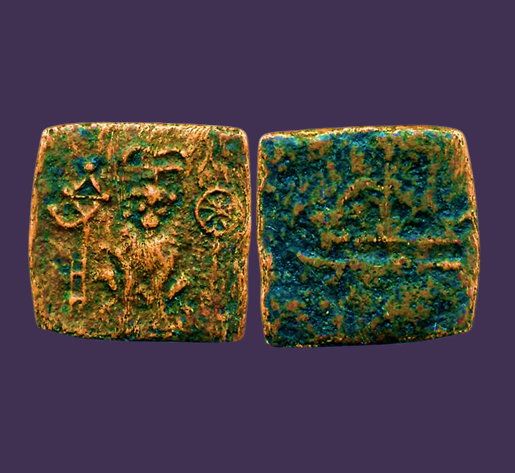
The showcased 2.64 g copper square coin is an intriguing example of this early Chera monetary tradition. Its imagery is dominated by a seated lion/tiger, accompanied by several powerful symbols. The obverse depicts a lion/tiger seated and facing the viewer, forming the principal design. Above the lion/tiger is a rayed Sun, while a flag appears on the left and a chakra (wheel) on the right. The reverse carries three important elements: an ankush (elephant goad), a bow and an arrow.
The use of the lion/tiger makes this variety particularly interesting within Sangam Chera coinage. While the elephant is frequently encountered on early Chera copper pieces, other animal types also occur in the wider series.
The surrounding symbols add to the visual vocabulary of the coin. The rayed Sun is a familiar celestial motif in early Indian coinage, while the chakra is an ancient symbol with religious and political associations. The flag or standard further reinforces the theme of royal authority.
The bow and arrow are particularly significant because they constitute the principal dynastic emblem associated with the Cheras. Their repeated appearance on Chera coinage makes them an important numismatic marker of Chera identity.
The ankush, placed alongside the bow and arrow, is another motif encountered on early Chera copper coins. It may be understood as an object associated with the control of elephants, complementing the importance of the elephant in the symbolic repertoire of early Chera coinage. A Sangam-age Chera coin in the collection of the Napier Museum similarly features an elephant on the obverse and a bow, arrow and ankusha on the reverse.
-
Decoding the Symbols of a Sangam Age Pandyan Copper Coin
2026-10-08 ThuThe Sangam age is generally placed broadly between c. 300 BCE and 300 CE, although the chronology...
-
Royal Emblems on a Gold Kahavanu of Rajendra Chola
2026-10-07 WedRajendra Chola I (1012–1044 AD) was one of the most powerful rulers of the Chola dynasty and th...
-
Parasu-Type Copper Coin of Venad Cheras
2026-10-07 WedThe Venad Cheras formed an important branch of the medieval Chera tradition in the southern part ...
-
Elephant and Lion/Tiger on a Rare Copper Coin of the Sangam Cholas
2026-10-06 TueThe Cholas were one of the three great Tamil dynasties of the Sangam age, alongside the Cheras an...
-
Pandya Dhananjaya Gold Gadyana of the Alupas of Alvakheda
2026-10-06 TueThe Alupas, also known as the Alupa dynasty, were an important ruling house of the coastal Karnat...