
2026-09-09 Wed
The Telugu Cholas, also known as the Telugu Chodas, comprised several branches that ruled different parts of the Andhra country during the medieval period. Among them, the Nidugal or Nellore branch emerged as one of the most powerful. Its rulers controlled the Nellore region and, at various times, extended their authority into parts of present-day Andhra Pradesh and Tamil Nadu. The dynasty claimed descent from the illustrious early Tamil Chola ruler Karikala Chola, reflecting its political and cultural connection with the Imperial Cholas of Tamil country.
Manuma Siddhi III, also known as Manmasiddha III, was one of the prominent rulers of the Nellore branch of the Telugu Cholas. He succeeded his father, Tikka Choda I, and ruled during the mid-13th century, at a time when the political landscape of southern India was marked by competition among the Cholas, Pandyas, Kakatiyas and other regional powers.
His earliest known records date from around 1249 CE, and inscriptions show his authority in the Nellore region. His reign coincided with the period when the power of the Nellore Cholas was approaching its zenith, although the kingdom subsequently became increasingly vulnerable to external intervention and internal conflicts.
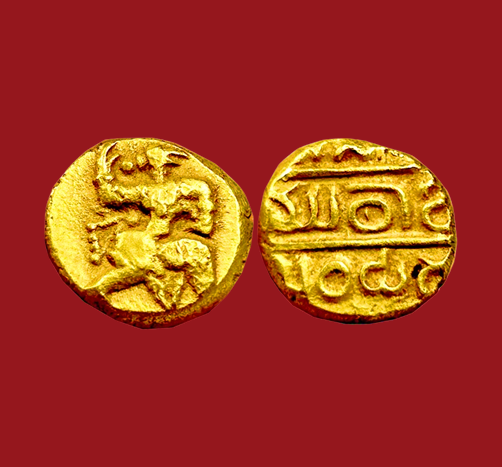
The coinage of the Nidugal or Nellore Cholas provides another dimension to their history. The use of Garuda and the legend invoking Danava Murari reveal a strong Vaishnava association, while the distinctive gold Gadyana demonstrates the sophistication of their monetary system.
Here, the coin is a rare gold Gadyana weighing 3.42 grams. The obverse of the coin shows, Garuda is running towards the right in a Chapetadana mudra. On the reverse, a three-line Telugu legend reads “Danava Murari Bantaru.”
Garuda, the vehicle (vahana) of Lord Vishnu, is a particularly significant symbol on a coin associated with a Vaishnava religious tradition. The expression may be understood as referring to the king as the servant of Danava-Murari, an epithet of Lord Vishnu or Krishna meaning “the enemy of the demon.” The type is recorded as extremely rare in numismatic.
This rare coin therefore represents more than a medium of exchange: it is an important historical record of the political identity, religious affiliation and cultural world of the medieval Telugu Cholas.
-
Goddess Laxmi holding Lotus and feeding Peacock on the Kumargupta I’s Gold Coin
2026-10-23 FriThe Gupta Empire (4th–6th centuries CE) occupies a distinguished place in Indian history, renow...
-
Chola Influence on Sri Lankan Coinage through Gold Kahavanu
2026-10-23 FriThe history of Sri Lankan coinage offers fascinating insights into the political, commercial and ...
-
Bronze Coin of Zeionises, Kshatrapa of Chuksa
2026-10-22 ThuThe Indo-Scythians, also known as the Sakas, were Central Asian peoples who migrated into the nor...
-
Silver Drachma of the Western Kshatrapas Ruler Viradaman
2026-10-22 ThuThe Western Kshatrapas were an important dynasty that ruled parts of western and central India, p...
-
Silver Tetradrachm of the Northern Kshatrapas
2026-10-21 WedThe Kshatrapas of Kashmir form part of the fascinating history of the northwestern Indian subcont...