
2026-10-21 Wed
The Kshatrapas of Kashmir form part of the fascinating history of the northwestern Indian subcontinent, a region shaped by the movement of Central Asian peoples and the interaction of diverse cultures. Among these were the Sakas, or Scythians, who established their authority over territories in present-day Pakistan and northwestern India. Their rulers adopted the title Kshatrapa, derived from an Old Persian term meaning governor or territorial protector. Over time, some Kshatrapas exercised considerable autonomy, leaving behind a rich numismatic legacy.
Chukhsa, an ancient region associated with the Taxila area, is closely connected with Zeionises, an important ruler of this tradition. Although sometimes grouped under the Kshatrapas of Kashmir in numismatic classifications, his historical domain belonged to the wider northwestern frontier. Known through his coins and inscriptions, Zeionises provides valuable evidence of the political and cultural interactions that characterised this region during the early centuries CE.
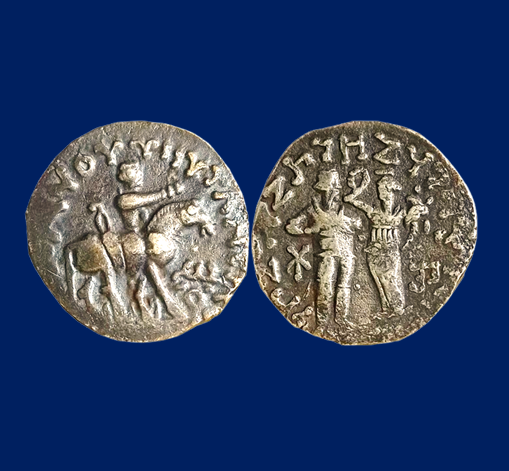
This silver tetradrachm of Zeionises, issued during his tenure as Kshatrapa, weighs 9.88 grams. Its distinctive imagery combines a mounted Scythian ruler with a classical representation of Tyche, illustrating the diverse artistic influences present in northwestern Indian coinage.
The obverse depicts a Scythian king advancing towards the right on horseback, holding an elephant goad. The dynamic equestrian figure conveys royal authority and military strength. A Nandipada symbol appears to the left, while a monogram occupies the right side. A Bactrian legend runs around the design, reflecting the region's enduring Hellenistic and Central Asian cultural connections.
The reverse portrays a king standing and facing right, while Tyche, the classical goddess associated with fortune and prosperity, stands to the left and crowns him with a wreath. She holds a cornucopia, symbolising abundance. A monogram appears to the left, and a Kharosthi inscription encircles the composition.
The inscription reads, “Manigulasaputrasa chatrapasa Jihuniasa,” meaning “Of Jihunia, the Kshatrapa, son of Manigula.” This legend is particularly valuable because it identifies the ruler, records his title, and establishes his paternal lineage.
The combination of Bactrian and Kharosthi legends, regional symbols, and Hellenistic-inspired imagery makes this tetradrachm an important historical artefact. It illustrates how the coinage of the northwestern subcontinent blended different artistic traditions while communicating political authority.
-
Numismatics Masterpiece - Gold Dodda Honnu of Krishnadevaraya, Vijayanagara Empire
2026-10-21 WedThe Vijayanagara Empire, founded in 1336, was one of the most influential powers in medieval Sout...
-
Celebrate the Spirit of Dussehra through Philately
2026-10-20 TueAs we celebrate the joyous festival of Dussehra, let us explore a special postage stamp that capt...
-
Goddess Parvati on a British Postage Stamp
2026-10-19 MonOn the auspicious occasion of Navaratri, let us explore a remarkable example of India’s artisti...
-
Goddess Durga on an East German Postage Stamp
2026-10-17 SatThe artistic and spiritual heritage of India has travelled far beyond its geographical boundaries...
-
Goddess Durga form – Palanchowk Bhagwati on a Nepalese Postage Stamp
2026-10-17 SatToday, we celebrate the seventh day of Navratri, dedicated to Goddess Kalaratri, one of the power...