
2026-10-22 Thu
The Western Kshatrapas were an important dynasty that ruled parts of western and central India, particularly present-day Gujarat, Maharashtra, and Malwa, from approximately the 1st to the 4th century CE. Their origins can be traced to the Sakas, or Scythians, a group of Central Asian peoples who migrated into the Indian subcontinent and established political authority across its northwestern and western regions.
The dynasty is generally associated with two major ruling houses: the Kshaharatas, represented by Nahapana, and the Kardamakas, founded by Chashtana. The Western Kshatrapas are particularly renowned for their silver coinage, which offers valuable evidence of their political history, royal succession, economic activity, and artistic traditions. Their coins typically feature a ruler's bust on the obverse and a distinctive combination of a three-arched hill, celestial symbols, and a Brahmi inscription on the reverse. The use of Greek-derived lettering alongside Indian scripts and religious or cultural motifs reflects the dynasty's position at the crossroads of Central Asian, Hellenistic, and Indian traditions.
Viradaman was a ruler of the Kardamaka branch of the Western Kshatrapas and the son of Mahakshatrapa Damasena, who ruled during the 3rd century CE. He served as Kshatrapa under his father. His name and position are known principally through his surviving coinage, which provides important evidence of his place within the royal succession. His silver coins bear an inscription identifying him as the son of Damasena and explicitly designate him as Kshatrapa rather than Mahakshatrapa.
The silver drachmas issued in Viradaman's name follow the characteristic monetary tradition of the Western Kshatrapas. They feature the familiar royal bust on the obverse and the dynastic emblem accompanied by a Brahmi inscription on the reverse.
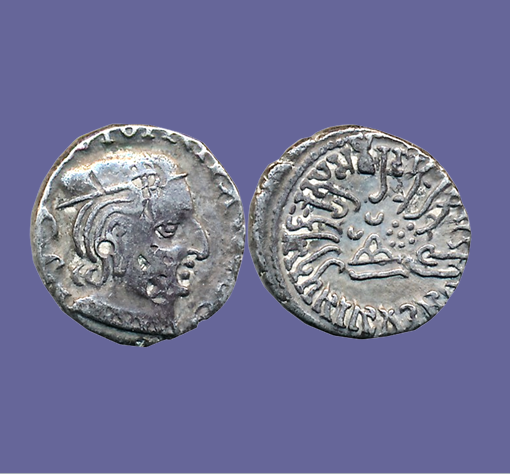
This silver drachma, weighing 2.18 grams, is a representative example of the coinage issued by Viradaman during his tenure as Kshatrapa. The obverse features the bust of the king, accompanied by Brahmi numerals behind the portrait and a sequence of corrupt Greek letters around the bust.
The reverse displays a three-arched hill, commonly identified as a chaitya or hill symbol, with a crescent positioned above it. The Sun appears to the right and another crescent to the left. These celestial symbols, together with the hill motif, form the characteristic reverse design of Western Kshatrapa silver drachmas. Encircling the central emblem is a Brahmi inscription written in Prakrit, beginning at approximately the 2 o'clock position and proceeding around the design. The legend reads, “Rajno MahaKshatrapasa Damasenasa Putrasa Rajnah Kshatrapas Virdamnah”. The inscription may be translated as: “Of the king, the Kshatrapa Viradaman, son of King Mahakshatrapa Damasena.”
-
Silver Tetradrachm of the Northern Kshatrapas
2026-10-21 WedThe Kshatrapas of Kashmir form part of the fascinating history of the northwestern Indian subcont...
-
Numismatics Masterpiece - Gold Dodda Honnu of Krishnadevaraya, Vijayanagara Empire
2026-10-21 WedThe Vijayanagara Empire, founded in 1336, was one of the most influential powers in medieval Sout...
-
Celebrate the Spirit of Dussehra through Philately
2026-10-20 TueAs we celebrate the joyous festival of Dussehra, let us explore a special postage stamp that capt...
-
Goddess Parvati on a British Postage Stamp
2026-10-19 MonOn the auspicious occasion of Navaratri, let us explore a remarkable example of India’s artisti...
-
Goddess Durga on an East German Postage Stamp
2026-10-17 SatThe artistic and spiritual heritage of India has travelled far beyond its geographical boundaries...