
2026-09-08 Tue
Manipur Kingdom, historically known as Kangleipak, was an important Meitei kingdom in the eastern part of the Indian subcontinent. Its royal history is recorded in the Cheitharol Kumbaba, the traditional chronicle of Manipur. The kingdom had close political relations with neighbouring Assam, Cachar and Burma.
The 18th century was an important period in Manipur's history. Under rulers such as Pamheiba, also known as Gharib Nawaz, the kingdom went through major political and religious changes. Vaishnavism also became increasingly influential. This troubled period is reflected in the coinage of Chaurajit Simha, an important ruler of Manipur in the early 19th century. Numismatic sources place Chaurajit after Labanya Chandra and Madhu Chandra. His coinage is generally dated to the early 1800s.
Chaurajit eventually became the dominant claimant. He defeated his brother and established his authority over the kingdom. His reign is generally placed in the early 19th century. Coin catalogues usually date his coinage to around 1804–1812. His reign was still politically difficult. His silver coins provide important evidence of the royal authority he tried to establish during this unsettled period.
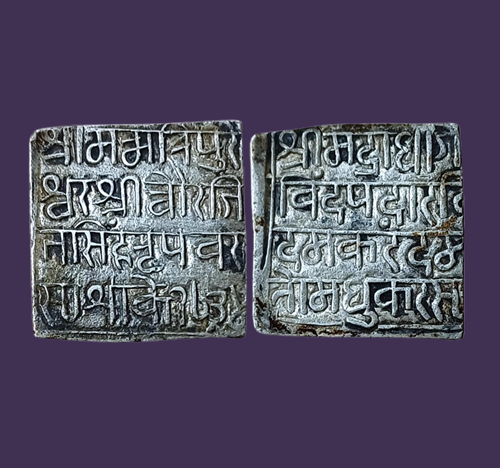
Here, the coin is a Silver Square Rupee of Chaurajit Simha. It weighs 11.72 grams. It is a hammered, square-shaped silver coin dated Saka 1734, corresponding to 1812 CE. An example weighing 11.72 grams has been recorded as an extremely fine and very rare specimen. The obverse of the coin has a Sanskrit inscription in Nagari script, “Shri man-Manipureshwara Shri Chaurajita Simha Nrupawarasya Shake 1734”. The inscription identifies Chaurajita Simha as the ruler or lord of Manipur and gives the Saka date as 1734.
The reverse has another Sanskrit inscription, “Shri mad-Radha-Govinda-Padaravinda Makaranda Manomadhukarasya”.
This is a devotional reference to the lotus feet of Radha-Govinda. It shows the strong influence of Vaishnavism on the religious culture of Manipur. Other Manipur coins from this period also contain references to Radha-Govinda.
However, the exact purpose of these silver rupees is still uncertain. N. G. Rhodes and S. K. Bose, in The Coinage of Manipur, questioned whether these coins were mainly used for everyday transactions or whether some of them had a ceremonial or royal-ritual purpose. The coin connects the history of royal succession, Vaishnavism, political authority and indigenous coinage.
-
Goddess Laxmi holding Lotus and feeding Peacock on the Kumargupta I’s Gold Coin
2026-10-23 FriThe Gupta Empire (4th–6th centuries CE) occupies a distinguished place in Indian history, renow...
-
Chola Influence on Sri Lankan Coinage through Gold Kahavanu
2026-10-23 FriThe history of Sri Lankan coinage offers fascinating insights into the political, commercial and ...
-
Bronze Coin of Zeionises, Kshatrapa of Chuksa
2026-10-22 ThuThe Indo-Scythians, also known as the Sakas, were Central Asian peoples who migrated into the nor...
-
Silver Drachma of the Western Kshatrapas Ruler Viradaman
2026-10-22 ThuThe Western Kshatrapas were an important dynasty that ruled parts of western and central India, p...
-
Silver Tetradrachm of the Northern Kshatrapas
2026-10-21 WedThe Kshatrapas of Kashmir form part of the fascinating history of the northwestern Indian subcont...