
2026-09-07 Mon
Sikkim became the 22nd state of India on 16 May 1975, bringing more than three centuries of Namgyal rule to an end. A referendum held on 14 April 1975 overwhelmingly supported the abolition of the monarchy and Sikkim's integration with India. The Constitution (Thirty-Sixth Amendment) Act, 1975 subsequently gave effect to Sikkim’s statehood and introduced special constitutional provisions under Article 371F.
The history of the kingdom, however, goes back more than three centuries. The Namgyal dynasty was established in the 17th century, when Phuntsog Namgyal was consecrated as the first Chogyal of Sikkim at Yuksom in 1642. The Chogyals, or consecrated rulers, governed Sikkim for more than 300 years, with Tibetan Buddhist traditions playing an important role in the political and cultural life of the kingdom.
Among the later rulers of Sikkim, Thutob Namgyal (1860–1914) occupies an important place. He became the ninth Chogyal in 1874 and ruled until his death in 1914. His reign coincided with increasing British influence in the Himalayan region and considerable political and social changes within Sikkim. Thutob Namgyal is remembered for his efforts towards administrative modernization. He reorganized aspects of the administration, established a Secretariat and encouraged the development of modern education. The first English school in Gangtok was established during his reign in 1875.
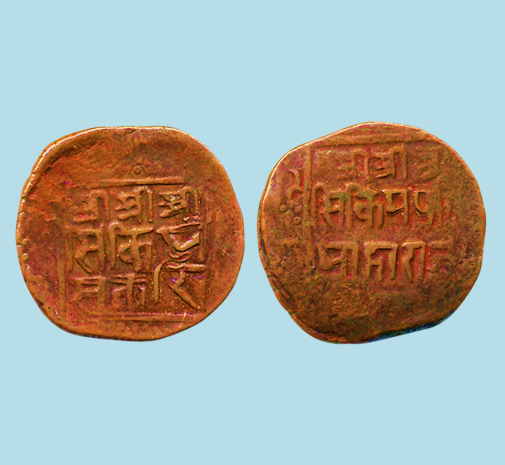
One of the most significant developments associated with the period was the shift of the capital from Tumlong to Gangtok in 1894. Sikkim’s coinage is unusual within the monetary history of the Indian Himalayan states. For much of its earlier history, the kingdom relied heavily on barter and the circulation of foreign or neighbouring currencies, including Tibetan and Indian money. These Sikkim copper pieces were issued as paisa and their designs closely followed contemporary Nepalese copper coinage. The coins are notable for their simple yet distinctive Nagari legends enclosed within a square. The denomination represented one paisa, or 1/64 of a rupee.
Here, the copper Paisa weighing 5.10 grams. The obverse depicts a three-line Nagari legend within a square, reading “Sri Sri Sri / Sikim-pati / Maharaj”. The reverse bears a three-line legend within a square, “Sri Sri Sri / Sikim / Sarkar”, referring to the Sikkim government.
-
Goddess Laxmi holding Lotus and feeding Peacock on the Kumargupta I’s Gold Coin
2026-10-23 FriThe Gupta Empire (4th–6th centuries CE) occupies a distinguished place in Indian history, renow...
-
Chola Influence on Sri Lankan Coinage through Gold Kahavanu
2026-10-23 FriThe history of Sri Lankan coinage offers fascinating insights into the political, commercial and ...
-
Bronze Coin of Zeionises, Kshatrapa of Chuksa
2026-10-22 ThuThe Indo-Scythians, also known as the Sakas, were Central Asian peoples who migrated into the nor...
-
Silver Drachma of the Western Kshatrapas Ruler Viradaman
2026-10-22 ThuThe Western Kshatrapas were an important dynasty that ruled parts of western and central India, p...
-
Silver Tetradrachm of the Northern Kshatrapas
2026-10-21 WedThe Kshatrapas of Kashmir form part of the fascinating history of the northwestern Indian subcont...