
2026-08-26 Wed
The Imperial Cholas were renowned not only for military expansion but also for their sophisticated administration, temple architecture, bronze sculpture, Tamil literature and extensive overseas connections. Their magnificent temples and inscriptions remain among the most important sources for understanding medieval South Indian history.
The Cholas were among the most powerful dynasties of medieval South India. Rising to prominence in the fertile Kaveri delta, they transformed themselves from a regional power into a formidable empire between the 9th and 13th centuries. Under rulers such as Vijayalaya Chola, Aditya I, Parantaka I, Rajaraja Chola I and Rajendra Chola I, the Chola kingdom expanded across much of southern India and established a remarkable maritime presence in the Indian Ocean. For more read, A Gangaikonda Series Coin Celebrating Rajendra Chola’s Northern Conquest
Uttama Chola, also known as Madhurantaka, ruled the Chola kingdom from approximately 973 to 985 CE. He was the son of Gandaraditya Chola and the celebrated queen Sembiyan Mahadevi. He succeeded Parantaka II (Sundara Chola) and was followed on the throne by Rajaraja Chola I, under whom the Chola Empire entered one of its greatest periods of expansion.
During his reign, consolidation of Chola authority and the development of the administrative and cultural foundations upon which the later imperial expansion was built.
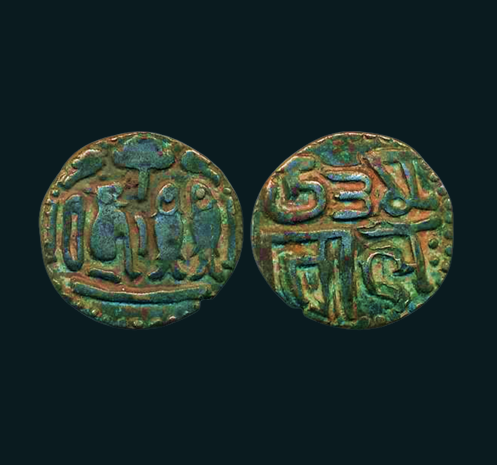
Uttama Chola's coinage is particularly fascinating because of its distinctive combination of dynastic symbols and Nagari legends. Silver and copper issues attributed to him feature the celebrated Chola emblematic group: the tiger, bow and twin fishes, placed beneath a royal parasol and accompanied by flywhisks.
The imagery carries an important political message. The tiger represents the Cholas, the bow is associated with the Cheras, and the twin fishes represent the Pandyas. Bringing these symbols together beneath the royal parasol visually expresses the Chola claim to supremacy over the major Tamil polities.
The use of Nagari script for the royal legend is another notable feature. The reverse of this coin type bears the legend “Uttama Cholah” in two lines, clearly identifying the ruler.
Here, the Base Silver Kahavanu of Uttama Chola, weighing 4.36 grams, is a striking example of this distinctive coinage. On the obverse, within a dotted border, a royal parasol occupies the upper portion of the design and is flanked by two flywhisks, symbols of royal authority. Beneath them are arranged, from left to right, a lampstand, a strung bow, the Chola tiger, two fishes and another lampstand. The reverse bears the Devanagari legend “U tta ma / Cho lah” in two lines, enclosed within a dotted border.
-
A Gangaikonda Series Coin Celebrating Rajendra Chola’s Northern Conquest
2026-08-26 Wed -
Gold Puvitta Anantha Varahan of Travancore Queen Rani Gouri Lakshmi Bayi
2026-08-25 Tue -
A Musician and Composer King's Copper Kasu
2026-08-25 Tue -
Golden “Jaya Chola” on Fanam in Nandinagari Script
2026-08-24 Mon -
“Yuddha Malla” on Rajaraja Chola I’s Gold Fanam – Symbols of Conquest
2026-08-24 Mon