
2026-11-17 Tue
The Post-Mauryan period (200 BCE–300 CE) witnessed the emergence of several regional kingdoms, local authorities and urban centres across the Indian subcontinent. With the decline of the Mauryan Empire, various independent political entities developed their own systems of administration, trade and coinage. The Ujjaini region, in present-day Madhya Pradesh, was among the important centres of political and commercial activity during this period. Its distinctive coinage reflects the religious beliefs, artistic traditions and symbolic vocabulary prevalent in the region.
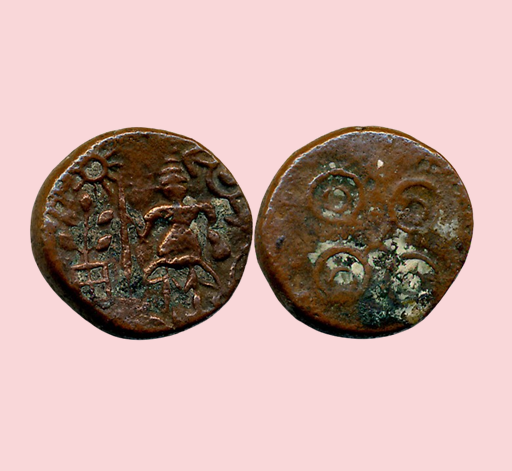
This interesting copper coin, weighing 3.47 g, represents the religious and numismatic traditions of the Post-Mauryan Ujjaini region. Its obverse features a standing figure of Lord Shiva, depicted holding a Kamandalu (water pot) in his left hand and a Danda (stick) in his right. The presence of Shiva on the coin is particularly noteworthy, as it provides an insight into the growing prominence of Shaivite religious imagery in early Indian coinage.
The surrounding symbols further enrich the composition. A sun symbol appears above a railed tree on the left side of the deity, while a six-armed symbol is positioned above a pair of taurines on the right. These motifs are characteristic of the symbolic repertoire found on ancient Indian punch-marked and cast coinages, although their precise religious or administrative significance remains a subject of interpretation. Their arrangement alongside the central deity creates a distinctive and elaborate visual composition.
The reverse displays a double-orbed Ujjain symbol, one of the most recognisable motifs associated with the region's ancient coinage. The Ujjain symbol generally consists of four interconnected circles arranged around a central point, with variations in their execution across different issues. Its repeated appearance on regional coins makes it an important numismatic identifier of the Ujjaini tradition.
The combination of the Ujjain symbol with the depiction of Shiva makes this coin an important example of the region's distinctive numismatic heritage. The use of copper as the medium also reflects the diversity of metals employed in ancient Indian monetary systems, particularly for coins intended for everyday circulation.
Beyond its monetary function, this coin offers valuable evidence of the integration of religious imagery and traditional symbols into early Indian coin designs. The depiction of Shiva, accompanied by the Kamandalu and Danda, distinguishes this issue from other regional varieties and highlights the artistic and religious expressions of the Post-Mauryan period.
-
Mithuna (Couple) Type Coin from the Post-Mauryan Ujjaini Region
2026-11-17 TueContinuing our exploration of the distinctive coinage of the Post-Mauryan Ujjaini region, let us ...
-
Rare Silver 1½ Shana Punch-Marked Coin of Panchala Janapada
2026-11-16 MonThe Panchala Janapada was one of the sixteen Mahajanapadas of ancient India, flourishing during t...
-
Earth God on Panchala Copper Coin of King Bhumimitra
2026-11-16 MonThe ancient kingdom of Panchala was one of the prominent Mahajanapadas of northern India. Located...
-
Silver Punch-Marked Coin of Vidarbha Janapada – Melghat Region
2026-11-13 FriThe emergence of Janapadas during the ancient period marked an important phase in India's politic...
-
Gold Pagoda of Jagaddeva, Paramara Ruler of Vidarbha
2026-11-13 FriThe Paramaras were an influential Rajput dynasty that established their power in central India, w...