
2026-11-18 Wed
The ancient region of Eran, situated in present-day Madhya Pradesh, was an important centre of early Indian culture, trade and coinage. Continuing our exploration of the fascinating coinage of the Eran-Vidisha region, this remarkable copper square karshapana offers an insight into the distinctive artistic and symbolic traditions of the Post-Mauryan period.
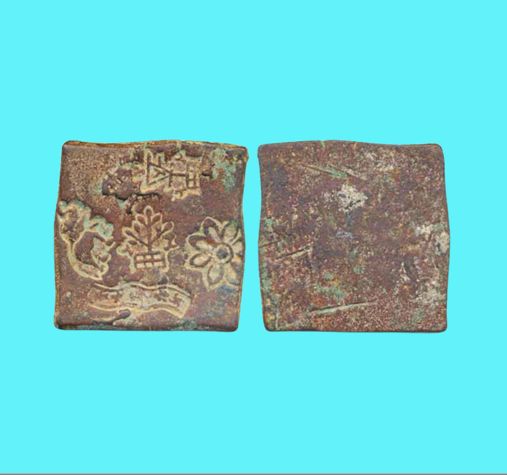
Weighing 10.12 grams, equivalent to approximately 80 rattis, this coin belongs to the uninscribed series of Eran copper issues. It follows the punch-marked technique, in which individual symbols were impressed onto the coin using separate punches. Unlike many contemporary coins bearing a single dominant motif, this specimen features five distinct symbols on its obverse, arranged in an interesting composition. The reverse is completely blank.
The first symbol depicts a flowing river, with fishes and turtles represented within its waters towards the bottom. This aquatic imagery highlights the importance of rivers and freshwater resources in ancient Indian life. To its left is an elephant walking towards the right, an animal frequently represented in early Indian art and coinage, possibly reflecting associations with power, prosperity and royalty.
At the centre is a tree enclosed within a railing, a recurring motif in early Indian numismatics. Such representations are generally associated with sacred tree veneration and nature worship. The tree is flanked by an eight-petalled flower, adding another distinctive element to the composition. Floral motifs were widely employed in ancient Indian art and often carried auspicious associations.
The fifth symbol, positioned towards the top, represents an inverted triangular fire altar enclosed within a railing. Fire altars are significant elements in ancient Indian religious and ritual traditions, and their appearance on early coinage provides an interesting glimpse into the symbolic vocabulary of the period.
Together, these five carefully executed symbols create a striking visual composition, bringing together elements of nature, sacred architecture, animals and ritual practices. This substantial copper karshapana is a fine example of the diversity of early Indian coinage and the rich numismatic heritage of the Eran region.
-
Sacred Symbols and Natural Motifs on Post-Mauryan Coinage of the Eran-Vidisha Region
2026-11-18 WedThe decline of the Mauryan Empire in the second century BCE marked the emergence of several regio...
-
Mithuna (Couple) Type Coin from the Post-Mauryan Ujjaini Region
2026-11-17 TueContinuing our exploration of the distinctive coinage of the Post-Mauryan Ujjaini region, let us ...
-
Lord Shiva Standing Type Copper Coin of the Ujjaini Region from Post-Mauryan Period
2026-11-17 TueThe Post-Mauryan period (200 BCE–300 CE) witnessed the emergence of several regional kingdoms, ...
-
Rare Silver 1½ Shana Punch-Marked Coin of Panchala Janapada
2026-11-16 MonThe Panchala Janapada was one of the sixteen Mahajanapadas of ancient India, flourishing during t...
-
Earth God on Panchala Copper Coin of King Bhumimitra
2026-11-16 MonThe ancient kingdom of Panchala was one of the prominent Mahajanapadas of northern India. Located...