
2026-11-18 Wed
The decline of the Mauryan Empire in the second century BCE marked the emergence of several regional powers and local political centres across the Indian subcontinent. This period, commonly known as the Post-Mauryan period, witnessed considerable diversity in coin production, with regional authorities and local communities developing distinctive monetary traditions. The Eran-Vidisha region of present-day Madhya Pradesh was among the important centres of ancient Indian coinage, renowned for its distinctive copper issues featuring a variety of religious, natural and geometric symbols.
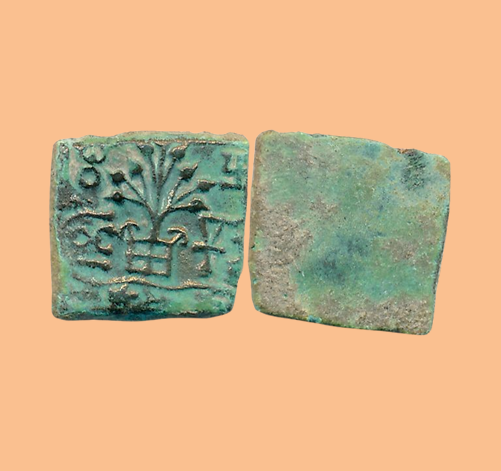
The present coin is an interesting example of the uniface cast copper coinage attributed to the Eran-Vidisha region. Weighing 1.64 grams, this coin is uniface, meaning that its designs are depicted on only one side, while the other side remains uninscribed. Despite its small size, the coin displays an elaborate arrangement of multiple symbols, reflecting the artistic and cultural traditions of the period.
At the centre is a tree enclosed within a railing, a frequently encountered motif in early Indian coinage. Such depictions are generally associated with the veneration of sacred trees and may represent the importance of nature worship in ancient Indian religious practices. To the left appears a Nandipada, a symbol resembling a taurine or sacred footprint, while a Swastika, an auspicious emblem associated with well-being and prosperity, is also featured. On the right is an Indradhvaja, or ceremonial standard, another familiar symbol in early Indian numismatic traditions.
The lower portion of the coin features a representation of a river with a tortoise, adding an interesting natural element to the overall composition. Rivers held immense significance in ancient Indian life, serving as vital sources of water, agriculture, trade and transportation. The presence of the tortoise further enriches the imagery, although its precise symbolic significance on this particular coin remains uncertain.
This remarkable coin offers a glimpse into the artistic vocabulary, symbolic traditions and regional identity of the Eran-Vidisha region during the Post-Mauryan period. It also demonstrates how early Indian coinage served not merely as a medium of exchange but as a reflection of the cultural and religious landscape of its time.
-
An Interesting Five-Symbols on Punch-Marked Copper Square Karshapana of Eran
2026-11-18 WedThe ancient region of Eran, situated in present-day Madhya Pradesh, was an important centre of ea...
-
Mithuna (Couple) Type Coin from the Post-Mauryan Ujjaini Region
2026-11-17 TueContinuing our exploration of the distinctive coinage of the Post-Mauryan Ujjaini region, let us ...
-
Lord Shiva Standing Type Copper Coin of the Ujjaini Region from Post-Mauryan Period
2026-11-17 TueThe Post-Mauryan period (200 BCE–300 CE) witnessed the emergence of several regional kingdoms, ...
-
Rare Silver 1½ Shana Punch-Marked Coin of Panchala Janapada
2026-11-16 MonThe Panchala Janapada was one of the sixteen Mahajanapadas of ancient India, flourishing during t...
-
Earth God on Panchala Copper Coin of King Bhumimitra
2026-11-16 MonThe ancient kingdom of Panchala was one of the prominent Mahajanapadas of northern India. Located...