
2026-08-26 Wed
The Cholas were one of the most powerful and long-lasting dynasties of South India. Their origins can be traced to the fertile Kaveri delta of Tamil Nadu, and by the 9th century they had emerged as a major imperial power. Under rulers such as Vijayalaya Chola, Aditya I, Parantaka I, Rajaraja Chola I and Rajendra Chola I, the Chola state expanded dramatically across southern India and beyond.
The Imperial Cholas were distinguished not only by their military achievements but also by their sophisticated administration, monumental temple architecture, flourishing Tamil culture and extensive maritime activity. Their influence reached Sri Lanka and the Maldives, while Chola naval expeditions extended their power and commercial influence across the Bay of Bengal and into Southeast Asia.
The son and successor of the celebrated Rajaraja Chola I, Rajendra Chola I ruled from approximately 1014 to 1044 CE. He inherited a powerful and well-organised empire from his father and expanded it to its greatest territorial and maritime extent.
Rajendra continued the Chola campaigns in Sri Lanka, bringing the island under Chola rule. His most celebrated achievement, however, was his northern expedition towards the Ganges. Around 1022–23 CE, Chola forces advanced through eastern and northern India, defeating several rulers before reaching the Ganges. The expedition was commemorated by Rajendra's adoption of the illustrious title “Gangaikonda Chola” — “the Chola who conquered the Ganges.”
To commemorate this achievement, Rajendra established a new imperial capital, Gangaikondacholapuram, which is in Tamil Nadu. The sacred Ganges water brought back from the northern expedition was associated with the great Cholagangam reservoir constructed near the new capital.
Rajendra was also a formidable maritime ruler. In 1025 CE, Chola forces launched a major naval expedition against the Srivijaya realm in Southeast Asia. The campaign demonstrated the remarkable naval capabilities of the Chola state and reinforced its position as a major power in the Indian Ocean and Bay of Bengal.
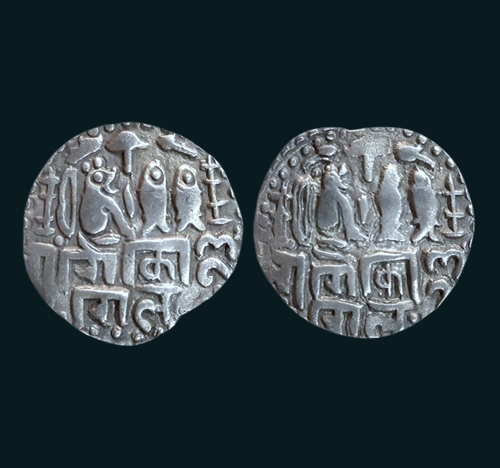
Chola coins frequently incorporated the dynasty's distinctive tiger emblem, accompanied by symbols associated with the territories brought under Chola authority. The bow represented the Cheras, while the twin fish represented the Pandyas. The combination of these symbols conveyed the political supremacy of the Chola ruler over the three major Tamil powers.
Rajendra's coinage is known in gold, silver and copper, with several varieties carrying legends in Nagari script. Among the most significant are coins bearing the legend “Gangaikonda Chola,” directly associating the emperor with his celebrated northern conquest.
The imagery on these coins is particularly striking. The royal parasol and flywhisks symbolise sovereignty, while the tiger, bow and twin fishes bring together the principal emblems of the Chola, Chera and Pandya traditions.
Here, the Silver Kahavanu of Rajendra Chola I, weighs 4.27 grams. The obverse depicts a royal parasol, which is flanked by two flywhisks. Below it appear, from left to right, a lampstand, a strung bow, the seated Chola tiger, two fishes, and another lampstand within a border of dots. The reverse carries the Devanagari legend “Gangaikonda Chola”, again within a dotted border.
-
Uttama Chola’s Rare Kahavanu Carries a Tiger beneath the Parasol
2026-08-26 Wed -
Gold Puvitta Anantha Varahan of Travancore Queen Rani Gouri Lakshmi Bayi
2026-08-25 Tue -
A Musician and Composer King's Copper Kasu
2026-08-25 Tue -
Golden “Jaya Chola” on Fanam in Nandinagari Script
2026-08-24 Mon -
“Yuddha Malla” on Rajaraja Chola I’s Gold Fanam – Symbols of Conquest
2026-08-24 Mon