
2026-08-24 Mon
Rajaraja Chola I (reign – c. 985–1014 CE) is regarded as one of the greatest rulers of medieval South India. Under him and his son, the Chola state reached the height of its political, military and maritime power.His coinage is remarkable not only for its royal imagery but also for the scripts used to express his titles and names. To know more about the ruler and about the dynasty, read “Yuddha Malla” on Rajaraja Chola I’s Gold Fanam – Symbols of Conquest
The legend on Chola coins were generally inscribed with a hitherto less known sister script of Deva Nagari called Nandi Nagari, which was more prevalent in Southern India. It is noted that Nandi Nagari and Deva Nagari represent two forms of the Nagari script. During the later ancient and early south Indian eras, Nandi Nagari was profusely and officially used in inscriptions, copper plates, manuscripts, and on the coins of Vera Kerala, Vijayanagara emperors, and Chola Emperors. The script was later continued to be used by Tanjavur/ Tanjore Marathas and Gooty chiefs. Click here, to read more, Naga Panchami - Worship of Snake on Coins and Subbaraya Gold Fanam
The development of Nandinagari has even deeper roots in the region. Some of the earliest Nagari inscriptions recorded in Tamil Nadu are associated with the Pallavas. The Tamil Nadu Department of Archaeology identifies inscriptions of Narasimha Pallava at Saluvankuppam and the Kailasanatha Temple inscription of Rajasimha Pallava among the early examples of Nagari writing in Tamil Nadu.
The connection with the Pallavas is particularly fascinating for numismatists. The Pallavas had already incorporated Sanskritic writing traditions into their royal and cultural expression centuries before Rajaraja Chola I. Their script tradition—often associated with Pallava-Grantha—played a major role in transmitting Sanskrit across South and Southeast Asia. The Pallava period therefore represents an important stage in the development and dissemination of scripts used for Sanskrit in southern India.
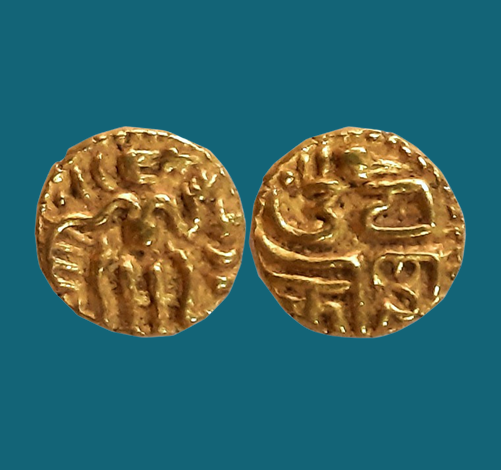
The present coin is a Gold ½ Fanam of Rajaraja Chola I, weighing 0.71 grams. It obverse features a standing king facing right. The reverse showcases the two-line legend “Jaya Chola”, written in the Nagari tradition. The legend Jaya Chola may be understood as “Victorious Chola”, expressing the military and imperial character of Rajaraja's reign.
-
An Interesting Five-Symbols on Punch-Marked Copper Square Karshapana of Eran
2026-11-18 WedThe ancient region of Eran, situated in present-day Madhya Pradesh, was an important centre of ea...
-
Sacred Symbols and Natural Motifs on Post-Mauryan Coinage of the Eran-Vidisha Region
2026-11-18 WedThe decline of the Mauryan Empire in the second century BCE marked the emergence of several regio...
-
Mithuna (Couple) Type Coin from the Post-Mauryan Ujjaini Region
2026-11-17 TueContinuing our exploration of the distinctive coinage of the Post-Mauryan Ujjaini region, let us ...
-
Lord Shiva Standing Type Copper Coin of the Ujjaini Region from Post-Mauryan Period
2026-11-17 TueThe Post-Mauryan period (200 BCE–300 CE) witnessed the emergence of several regional kingdoms, ...
-
Rare Silver 1½ Shana Punch-Marked Coin of Panchala Janapada
2026-11-16 MonThe Panchala Janapada was one of the sixteen Mahajanapadas of ancient India, flourishing during t...