
2026-08-24 Mon
The Cholas were one of the most powerful and influential Tamil dynasties of South India. Although the Cholas have a much older history reaching back to the Sangam age, they emerged as a major imperial power from the 9th century onward. Their territories eventually extended across much of South India and into Sri Lanka and the wider Indian Ocean world. Under rulers such as Rajaraja Chola I and his son Rajendra Chola I, the Chola state reached the height of its political, military and maritime power.
Rajaraja Chola I (reign – c. 985–1014 CE) is regarded as one of the greatest rulers of medieval South India. When he came to the throne, he embarked on an ambitious program of military expansion that transformed the Chola kingdom into a major empire.
Rajaraja defeated the Chera and Pandya powers, brought large parts of southern India under Chola authority and expanded Chola control into Sri Lanka. His campaigns also extended Chola influence across the Indian Ocean, while his reign laid the foundations for the even greater overseas expansion achieved by his son, Rajendra Chola I.
He was an accomplished administrator who reorganised territories and strengthened the machinery of imperial government. His reign is particularly well documented through extensive temple inscriptions, which provide valuable information about administration, taxation, land grants and society.
His most celebrated architectural achievement was the magnificent Brihadisvara Temple at Thanjavur, completed during his reign. The monumental temple became one of the greatest expressions of Chola architecture and remains a landmark of South Indian history.
The expansion of the Chola Empire was accompanied by a distinctive and highly symbolic coinage. Chola coins frequently incorporated the dynasty's principal royal emblems – tiger, bow and fish. This represents the political identity and territorial ambitions of the Cholas.
The tiger was the traditional emblem of the Cholas, while the fish represented the Pandyas and the bow the Cheras. The combination of these symbols on a single coin is particularly significant in the context of Chola imperial expansion.
Rajaraja's coinage was produced in gold, silver and copper, and included different denominations and types. Among the most fascinating are the tiny gold pieces generally identified as Fanams or fractional Kahavanus, which carried remarkably elaborate designs despite their small size.
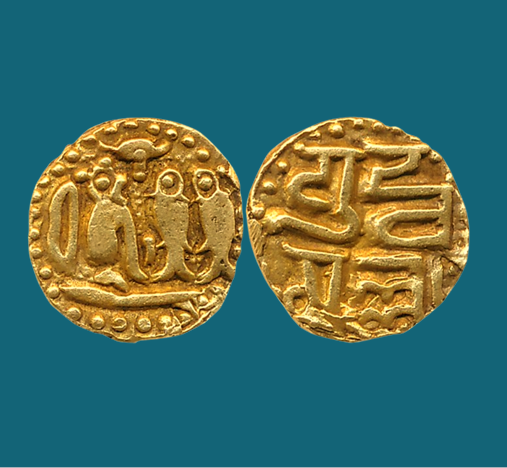
Here, the Gold Fanam weighs 0.49 grams. The obverse of the coin depicts Tiger within a dotted circle, accompanied by a parasol above two fishes, while a strung bow is placed to the left. The reverse features two-line Nandinagari legend “Yuddha Malla” within a dotted circle.
-
Golden “Jaya Chola” on Fanam in Nandinagari Script
2026-08-24 Mon -
Golden Lion on Tanjore King Sarabhoji I’s Fanam
2026-08-21 Fri -
Rare Fanam of the First Tanjore Maratha: Venkoji’s Golden Legacy
2026-08-21 Fri -
Rare Gold Gadyana of Barma Bhupala of Torgal: Local Power in the Kalachuri Deccan
2026-08-20 Thu -
Rare Gold Lakshmi Coin of King Naravarman, Paramara of Malwa
2026-08-20 Thu