
2026-06-18 Thu
The Satavahanas were a major ancient Indian dynasty that ruled large parts of the Deccan i.e. southern, central and western India that comprises of modern Maharashtra, Andhra Pradesh, Telangana, Karnataka, and parts of Madhya Pradesh and Gujarat. They ruled approx. from the late 2nd century BCE to the early 3rd century CE. Sri Mukha, the founder of the dynasty overthrew the remnants of the Kanva dynasty and local powers and established his rule in the upper Godavari valley.
Satavahana coinage is one of the most important sources for understanding the dynasty. Their regional economies, trade, and cultural influences can be traced through its coinage. They issued coins in Lead, Potin, Copper, Bronze, Silver and Gold. Their important mints were located at Paithan, Nashik, Vidarbha. The legends on their coinage are found in Brahmi, Tamil/Telugu scripts.
Siri Satakarni was the third king of the Satavahana dynasty. He ruled from 70 to 60 BCE. He expanded the empire westward, conquering areas like Malwa from the Shungas. His rule strengthened Satavahana control over trade routes in the western Deccan. He performed grand Vedic rituals, including two Ashvamedha yajnas and a Rajasuya yajna, symbolizing sovereignty. These are recorded in detail in the famous Naneghat inscription.
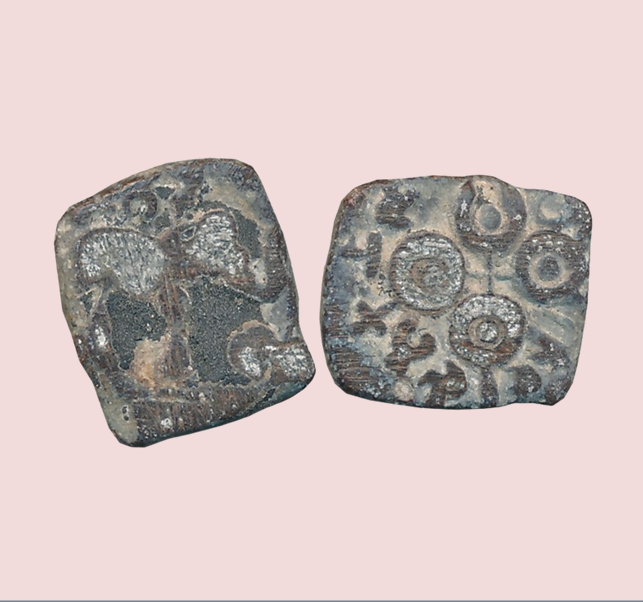
Coins of Siri Satakarni are among the early Satavahana issues, often in Lead, Copper or Potin. They commonly bear the Brahmi legend "(Siri) S?taka?i(sa)" on the obverse. It typically shows elephant or other animal motifs, Ujjain symbol (four circles) and symbols indicating royal authority.
Here, the Lead coin above weighs 2.95 grams. The obverse depicts elephant walking to right, traces of some symbol above the elephant. The reverse features Ujjaini symbol and Brahmi legend “Rajno Siri Satakanisa” around.
-
The Elephant on an Indo-Greek Silver Drachm of Apollodotus I
2026-09-22 TueElephants were not just an important part of Indian heritage and religious traditions; they also ...
-
Gajalakshmi Flanked by Elephants on a Post-Mauryan Ujjaini Copper Coin
2026-09-22 TueThe association between Gajalakshmi and elephants is one of the most enduring motifs in Indian re...
-
Elephant Head on a Bronze Coin of Indo-Scythian King Maues
2026-09-21 MonAs the eighth day of Ganesh Utsav is celebrated, the elephant once again provides a fascinating l...
-
A Remarkable Elephant-and-Lion Standard on Vrishni Coinage
2026-09-21 MonAs Ganesh Utsav continues, the elephant once again offers a fascinating doorway into India’s an...
-
Elephant and Lion on a Cooch Behar Royal Coin
2026-09-19 SatThe elephant occupies a distinctive place in the cultural traditions of eastern India, particular...