
Greek And Roman Deities On Coins-5
2026-01-14 Wed
#Greek traditions and folktales are rich with stories and #Legends, which are also reflected in various forms of art. Notably, many prominent events from these narratives have been captured on coinage. Thus, coins serve not only as a medium of exchange but also as a medium of #storytelling.One of the greatest and oldest #Heroes in Greek lore is Perseus. He was a slayer of #MONSTERS who came before #heracles. To learn more about Heracles, refer to the link below: Greek And Roman Deities On Coins-3. Born to #Zeus, the chief deity of the Greek pantheon, and the mortal mother Danae, Perseus is considered a demigod.
Perseus killed #Medusa, a Gorgon whose head had #snake-like #Hair, and her stare could turn people to stone. According to the folklore, Medusa was once a beautiful maiden, but #Athena (the goddess of #Wisdom and strategic #warfare) cursed her to be transformed into an ugly, snake-haired monster at the sacrilege within her #Temple, by #poseidon, the god of sea, for the act of rape. Athena blamed Medusa, not Poseidon.
The depiction of Perseus beheading Medusa is one of the earliest scenes that appear in art. To achieve this feat, Perseus used several #gifts: a shield that was also used as #mirror from Athena, winged sandals and a harpa #sword from #hermes (the god of travelers and messages), and a cap of invisibility from #Hades (the god of the Underworld).
Images of Perseus can be found on coins dating back to 550 BCE from Cyzicus (Kyzikos). To learn more about Cyzicus, refer to the link here: Greek And Roman Deities On Coins-2. He was a popular subject for #ancient coins, which featured various portrayals from different episodes of his adventures.
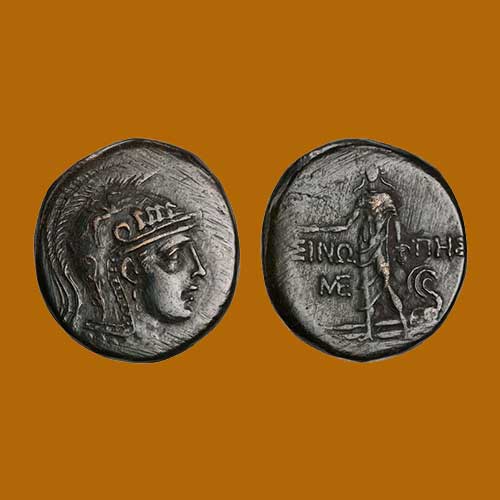
The coin highlighted in this post is a #Bronze Coin of Mithradates VI from Sinope, an ancient Greek city located on Turkey's Black Sea coast. The obverse features a bust of Athena, while the reverse showcases a standing Perseus with harpa sword on his right hand and head of Medusa on his left, with her body at his feet. Additionally, the coin features a monogram and the inscription ‘Sinopes’ in Greek.
Latest News
-
An Interesting Five-Symbols on Punch-Marked Copper Square Karshapana of Eran
2026-11-18 WedThe ancient region of Eran, situated in present-day Madhya Pradesh, was an important centre of ea...
-
Sacred Symbols and Natural Motifs on Post-Mauryan Coinage of the Eran-Vidisha Region
2026-11-18 WedThe decline of the Mauryan Empire in the second century BCE marked the emergence of several regio...
-
Mithuna (Couple) Type Coin from the Post-Mauryan Ujjaini Region
2026-11-17 TueContinuing our exploration of the distinctive coinage of the Post-Mauryan Ujjaini region, let us ...
-
Lord Shiva Standing Type Copper Coin of the Ujjaini Region from Post-Mauryan Period
2026-11-17 TueThe Post-Mauryan period (200 BCE–300 CE) witnessed the emergence of several regional kingdoms, ...
-
Rare Silver 1½ Shana Punch-Marked Coin of Panchala Janapada
2026-11-16 MonThe Panchala Janapada was one of the sixteen Mahajanapadas of ancient India, flourishing during t...