
Greek And Roman Deities On Coins-2
2026-01-09 Fri
Deities have been worshipped in diverse forms throughout human History. Each religion has outlined specific roles for the various gods that adorn its Pantheon. In Ancient times, royal inscriptions and artistic representations, including paintings and sculptures, as well as coinage, prominently displayed these deities.The representation of gods and goddesses on Coins serves as significant evidence of the religious beliefs held by particular rulers and illustrates the evolving patterns of deities represented throughout time. Many of these images are deeply intertwined with myths that reflect the historical narratives of their respective communities.
In Greek mythology, the twelve Olympians constitute the principal deities of the Greek pantheon, appearing on coins throughout various periods. Among these, Athena is the goddess of wisdom, strategic warfare, and crafts. A daughter of Zeus, the chief deity of the Greek pantheon, she is known as Minerva in Roman mythology. Artistic depictions of Athena typically feature her wearing a helmet and holding a spear. Furthermore, she is revered as the patron deity of Athens and is prominently portrayed on Silver tetradrachm coins alongside her emblem, the Owl, on the reverse.
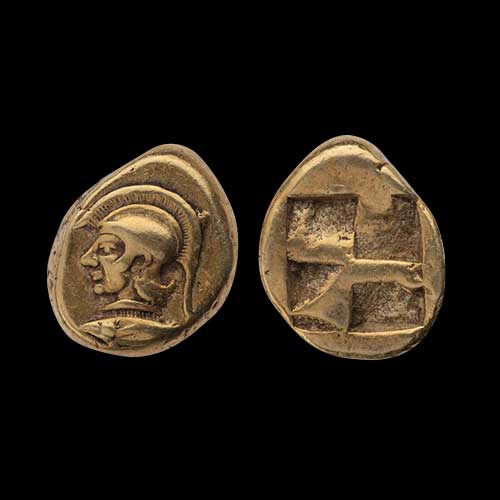
Athena’s representation on coins can be traced back to approximately 550 BCE to 475 BCE. Beginning around 800 BCE, ancient Greek city-states—many of which were maritime powers—sought to expand their Rule beyond Greece, leading to the establishment of colonies throughout the Mediterranean and Black Seas. The coin depicted here originates from Cyzicus or Kyzikos, an ancient Greek town located in Mysia, present-day Turkey.
Cyzicus was a strategically significant city on the northwestern coast of Anatolia, well positioned to take advantage of trade across the Sea of Marmara. The tuna fish emerged as a symbol of Cyzicus from the mid-6th century BCE, during which the city commenced the issuance of electrum staters and their fractional denominations. Notably, tuna fishing played a central role in the Economy of Cyzicus, yielding considerable wealth and becoming a motif of the city, as reflected in its coinage for many centuries.
The coin depicted here is an electrum Hekte from Cyzicus, featuring a depiction of Athena wearing a helmet on the obverse and a tuna fish below. The reverse showcases a counterclockwise swastika pattern / Quadripartite incuse square.
Latest News
-
The Elephant on an Indo-Greek Silver Drachm of Apollodotus I
2026-09-22 TueElephants were not just an important part of Indian heritage and religious traditions; they also ...
-
Gajalakshmi Flanked by Elephants on a Post-Mauryan Ujjaini Copper Coin
2026-09-22 TueThe association between Gajalakshmi and elephants is one of the most enduring motifs in Indian re...
-
Elephant Head on a Bronze Coin of Indo-Scythian King Maues
2026-09-21 MonAs the eighth day of Ganesh Utsav is celebrated, the elephant once again provides a fascinating l...
-
A Remarkable Elephant-and-Lion Standard on Vrishni Coinage
2026-09-21 MonAs Ganesh Utsav continues, the elephant once again offers a fascinating doorway into India’s an...
-
Elephant and Lion on a Cooch Behar Royal Coin
2026-09-19 SatThe elephant occupies a distinctive place in the cultural traditions of eastern India, particular...