
Greek And Roman Deities On Coins-3
2026-01-13 Tue
Herakles, also known as Hercules in Roman mythology, is one of the most celebrated heroes in Greek Mythology, revered in various forms of art, including sculptures, paintings, and coins. Coins featuring him are found in ancient Greek City states and Roman Empire. As the son of ZEUS, the KING of the Gods, and Alcmene, a mortal woman, he was born a demigod endowed with remarkable strength and power. Though Herakles held a place in the Greek pantheon, he is considered a demigod because of his mother’s mortality.His narrative is marked by numerous adventures, with the TWELVE most significant episodes known as the ‘Labours of Herakles,’ which he undertook in #service to King Eurystheus of Greek mythology. These labours have become a prominent theme in art, particularly on coins.
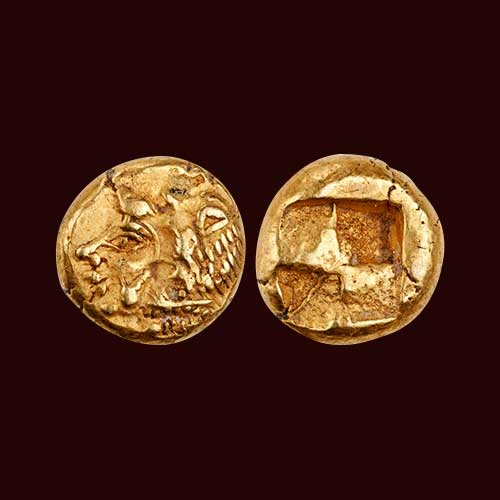
The first of his labours involved slaying a #Lion that terrorized the region of Nemea in northeastern #Greece. Following the lion's defeat, Herakles used its own claws to skin the creature and fashioned its pelt into #Armor, donning the lion's #head as a helmet. This iconic armor became a defining characteristic depicted on coins from as early as 550 BCE, including the coin featured here.
Interestingly, on the coins of Alexander of Macedonia and Roman Emperor Commodus, both of them are portrayed as the #Mythical hero Herakles, adorned with the Nemean Lion’s skin as a headdress.
The inception of coinage occurred in Lydia, in what is now western Turkey, during the 7th #century BCE. These early coins, made from electrum—a natural alloy of #GOLD and #Silver - featured a lion motif. The innovative coinage of the Lydians quickly spread to neighboring regions, leading to the Ionian Greeks in #Asia Minor issuing their own #Currency. Ionia represents an ancient region that encompasses the central part of the #western coast of Anatolia.
The coin featured is an Electrum Hekte from Ionia, showcasing the bust of Herakles wearing the lion's head on the obverse, while the reverse features a Swastika pattern/quadripartite incuse square.
Greek And Roman Deities On Coins-2
Latest News
-
Science and Technology on Indian Postage Stamps-32
2026-01-09 FriPrasanta Chandra Mahalanobis, widely regarded as the Father of Indian Statistics, was a distinguishe...
-
Greek And Roman Deities On Coins-2
2026-01-09 FriDeities have been worshipped in diverse forms throughout human History. Each religion has outlined s...
-
Science and Technology on Indian Postage Stamps-31
2026-01-09 FriThe Ooty Radio telescope (ORT), located in Muthorai near Ooty, Tamil Nadu, stands as one of the larg...
-
Malwa Sultan Mahmud Shah II's Silver Tanka
2026-01-07 WedMahmud Shah II was the last ruler of the #Khalji dynasty of the #Malwa #Sultanate, reigning from AH ...
-
Greek And Roman Deities On Coins-1
2026-01-07 WedCoins were introduced in Greece and India almost simultaneously. Lydian Lion coins are considered as...