
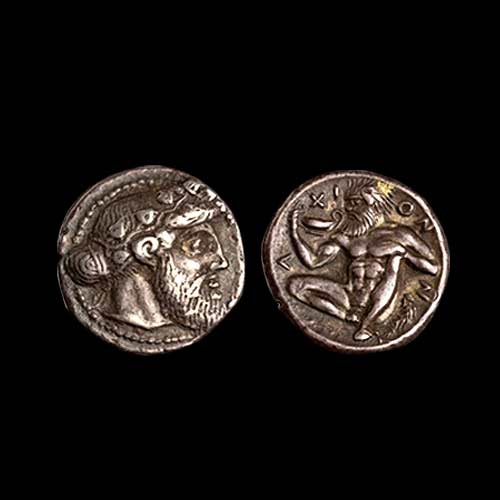
Greek And Roman Deities On Coins-1
2026-01-07 Wed
Coins were introduced in Greece and India almost simultaneously. Lydian Lion coins are considered as the first coins of the world. Since then, coins have been also used as a medium of conveying ideologies, religious affiliation, beliefs, nature, animals, and kings and Queen pertaining to many dynasties with devices like weapon, coat of arms, and monograms etc. associated with them.Ancient Greek coinage is generally categorized into three distinct periods, according to eras of Greek art: Archaic, Classical, and Hellenistic. The Archaic period is marked with establishment of Greek colonies throughout the Mediterranean in the 8th and 7th centuries BCE, approximately 2700 years ago. From the late Archaic Period to the Classical period, local coinages were minted in various Greek city-states across the Mediterranean. Each city that minted coins utilized unique imagery, iconography, and devices which conveyed the authority of the local state, reflecting the distinct identities of the Greek city-states and their citizens. This is the time Greek deities appeared on coins from the earliest periods.
Although Zeus is regarded as the #father of many deities, demigods, and Heroes, his son Dionysus appears on coins much earlier. Dionysus is revered in ancient Greek religion and mythology as the god of winemaking, orchards, fertility, festivity, Madness, and theatre. He has been portrayed on various denominations, including Half-Litra, Litra, Didrachm, Drachma, and Tetradrachm, particularly originating from Naxos. The bearded portrait of Dionysus as depicted above is found on tetradrachms and drachms during the period 461-430 BCE. The reverse is generally minted with images / engraving of bunch of grapes, a seated Silenus (a companion and tutor of Dionysus) holding a kantharos (a cup used in ancient Greece for drinking), or a simple kantharos.
Starting today, we’ll be uncovering fascinating facts about Greek and Roman deities featured on coins. We’d love to hear your thoughts and feedback! Stay tuned for some amazing insights!
Latest News
-
The Elephant on an Indo-Greek Silver Drachm of Apollodotus I
2026-09-22 TueElephants were not just an important part of Indian heritage and religious traditions; they also ...
-
Gajalakshmi Flanked by Elephants on a Post-Mauryan Ujjaini Copper Coin
2026-09-22 TueThe association between Gajalakshmi and elephants is one of the most enduring motifs in Indian re...
-
Elephant Head on a Bronze Coin of Indo-Scythian King Maues
2026-09-21 MonAs the eighth day of Ganesh Utsav is celebrated, the elephant once again provides a fascinating l...
-
A Remarkable Elephant-and-Lion Standard on Vrishni Coinage
2026-09-21 MonAs Ganesh Utsav continues, the elephant once again offers a fascinating doorway into India’s an...
-
Elephant and Lion on a Cooch Behar Royal Coin
2026-09-19 SatThe elephant occupies a distinctive place in the cultural traditions of eastern India, particular...