
Science and Technology on Indian Postage Stamps-32
2026-01-09 Fri
Prasanta Chandra Mahalanobis, widely regarded as the Father of Indian Statistics, was a distinguished scientist and statistician whose contributions have had a lasting impact on the field. He is best known for the Mahalanobis distance, a significant statistical measure, and for his role as a founding member of the first Planning Commission of independent India.Born on 29 June 1893, in the Bengal Presidency to a prominent family of intellectuals and social reformers, Mahalanobis was influenced by his grandfather, Guru Charan Mahalanobis, a follower of the Sadharan Brahmo Samaj. He began his formal education at the Brahmo Boys’ School, established by his grandfather in 1904. After graduating with honors in Physics from Presidency College, Calcutta (#Kolkata), in 1912, he pursued further studies in physics and mathematics at the University of Cambridge in England. It was there that he became acquainted with Biometrika, a peer-reviewed journal dedicated to theoretical statistics, which ignited his interest in the Discipline. He completed the Mathematics Tripos Part I in 1914 and the Physics Tripos Part II in 1915.
Mahalanobis began his professional career as a temporary professor at Presidency College in 1915 and later served as Principal. From 1922 to 1926, he held the position of Meteorologist at the Alipore observatory in Calcutta.
Rabindranath Tagore recognized Mahalanobis's keen interest in statistics early on and significantly influenced his career in the field. Upon learning of his passion, Tagore introduced him to Brajendranath Seal, an esteemed scholar and educator, who tasked the Mahalanobis with analyzing the exam records of Calcutta University.
In the early 1920s, Mahalanobis established the Statistical Laboratory at the Baker Laboratory of Presidency College, where his initial research focused on anthropometry, meteorology, and flood control problems in North Bengal and Odisha. This research laid the groundwork for the construction of the Hirakud Dam on the Mahanadi river.
Mahalanobis's first comprehensive study investigated the anthropometric measurements of Anglo-Indians in Calcutta, culminating in his inaugural paper titled 'Anthropological Observations on the Anglo-Indian of Calcutta Part-I Analysis of Male Stature,' published in the records of the Indian Museum in 1922.
On 17th #December 1931, he founded the Indian Statistical Institute (ISI) to promote advanced research and Training in statistics. Over the years, the ISI expanded its research endeavors to cover various fields, including biochemistry, crop Science, human genetics, psychometry, pre-census studies, and #Economics. Under Mahalanobis's leadership, the ISI conducted notable data analyses and extensive surveys, addressing critical topics such as the impact of the 1943 Bengal Famine, rural indebtedness, tea-drinking habits, crop yield estimation, family budgets, and the circulation of rupee coins. In the 1950s, the ISI relocated to its current facilities in Baranagar, a suburb of Kolkata, West Bengal. Additionally, Mahalanobis founded Sankhya, The Indian Journal of Statistics, in 1933, which remains the official publication of the ISI, with Mahalanobis serving as its editor from 1933 to 1972.
His research caught the attention of Jawaharlal Nehru, who invited Mahalanobis to participate in the Planning Commission and subsequently outlined the Second Five-Year Plan (1956-1961). This plan embraced what became known as the ‘Mahalanobis Model,’ emphasizing the development of the public sector and rapid industrialization.
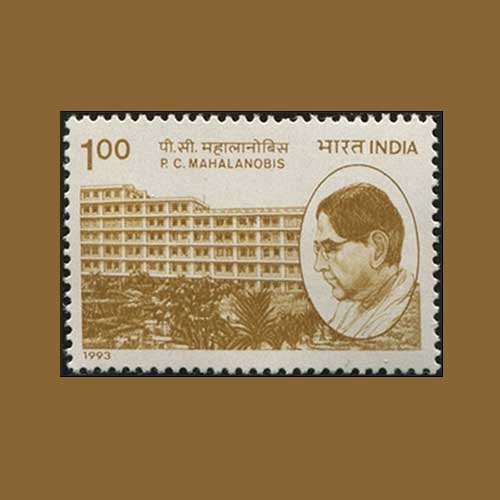
In recognition of his pioneering contributions, Mahalanobis was awarded the Padma Vibhushan in 1968. His legacy is honored annually on his birthday, which is observed as National Statistics Day. Furthermore, on 29 June 1993, India Post issued a commemorative stamp celebrating Prasanta Chandra Mahalanobis, marking his birth centenary, featuring his portrait alongside the Planning Commission Building.
Latest News
-
Uttama Chola’s Rare Kahavanu Carries a Tiger beneath the Parasol
2026-08-26 Wed -
A Gangaikonda Series Coin Celebrating Rajendra Chola’s Northern Conquest
2026-08-26 Wed -
Gold Puvitta Anantha Varahan of Travancore Queen Rani Gouri Lakshmi Bayi
2026-08-25 Tue -
A Musician and Composer King's Copper Kasu
2026-08-25 Tue -
Golden “Jaya Chola” on Fanam in Nandinagari Script
2026-08-24 Mon