
Fascinating Archaeological Facts on Postage Stamps - 57
2025-06-27 Fri
Kushinagar, situated in the Kushinagar district of Uttar Pradesh, is recognized as an important international Buddhist pilgrimage center. According to Buddhist texts, it is in Kushinagar that #Lord Buddha entered Mahaparinirvana, leaving behind his mortal body.Historically referred to as Kusinara, it served as the capital of the Mallas, one of the 16 Mahajanapadas, during the 6th century BCE. Over the centuries, Kushinagar has remained a significant site within various prominent empires, including the Maurya, Shunga, Kushana, Gupta, and Pala.
The initial assessment of Kushinagar's historical significance was conducted by H. H. Wilson in 1854. This was followed by the efforts of Alexander Cunningham and his assistant A.C.L. Carlleyle, who discovered a variety of antiquities, including inscriptions, seals, and #Coins, which further highlighted the site's importance.
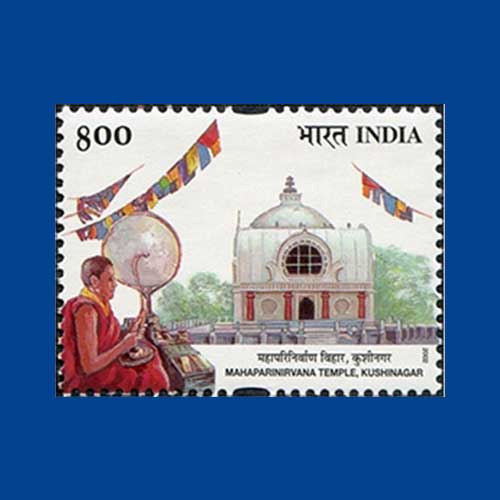
Significant structures at Kushinagar include the Mahaparinirvana #Temple, Parinirvana Stupa, and Ramabhar Stupa. For further insights into the Ramabhar Stupa, please refer to This Post
In 1876, Carlleyle uncovered the remnants of the Mahaparinirvana Temple, along with a damaged 6.1-meter-long statue of the reclining Lord Buddha. The #ArchaeologicalSurveyofIndia (#ASI), under Carlleyle's direction, restored the #BROKEN #statue, temple, and several other structures.
The Mahaparinirvana Temple is believed to have been initially constructed by Emperor ashoka and later expanded by the Gupta rulers. A 5th-century CE inscription found at the site attributes the statue to Haribala, a disciple of the Lord Buddha, as a religious gift.
The statue, crafted from a single block of red sandstone, depicts the Buddha in the posture he assumed at the time of his #Death, reclining on his right side with his head to the north, #feet to the #South, and #face oriented toward the west. It is mounted on a pedestal adorned with three #human figures on its western side.
Adjacent to the temple is the Parinirvana Stupa, made of #bricks, which stands at a height of 2.74 meters. This stupa is raised on a circular base and crowned with a #dome. It was initially excavated by Carlleyle in 1876, and further excavations in 1910 revealed a copper vessel and a copper plate, as well as another vessel containing #Silver coins from Kumar Gupta.
The current form of the Mahaparinirvana Temple was established in 1956, during renovations commemorating the 2500th anniversary of Buddha Jayanti.
Moreover, the Mahaparinirvana Temple and Parinirvana Stupa was featured on a commemorative stamp issued by #India Post as part of the 'Baudhha Mahotsav' Festival Series on 21 January 2002, with a face value of Rs 8.
Latest News
-
The Elephant on an Indo-Greek Silver Drachm of Apollodotus I
2026-09-22 TueElephants were not just an important part of Indian heritage and religious traditions; they also ...
-
Gajalakshmi Flanked by Elephants on a Post-Mauryan Ujjaini Copper Coin
2026-09-22 TueThe association between Gajalakshmi and elephants is one of the most enduring motifs in Indian re...
-
Elephant Head on a Bronze Coin of Indo-Scythian King Maues
2026-09-21 MonAs the eighth day of Ganesh Utsav is celebrated, the elephant once again provides a fascinating l...
-
A Remarkable Elephant-and-Lion Standard on Vrishni Coinage
2026-09-21 MonAs Ganesh Utsav continues, the elephant once again offers a fascinating doorway into India’s an...
-
Elephant and Lion on a Cooch Behar Royal Coin
2026-09-19 SatThe elephant occupies a distinctive place in the cultural traditions of eastern India, particular...