
Fascinating Archaeological Facts on Postage Stamps - 50
2025-06-23 Mon
Kushinagar, referred to as #Kusinara in Pali, is located near #gorakhpur in Uttar Pradesh and holds significant importance as a buddhist pilgrimage site, where Gautama Buddha attained Mahaparinirvana.Based on literary references and archaeological evidence, Kushinagar served as a Central hub for both political and religious activities from 600 BCE to 1200 CE. At the time of Buddha’s death, the city was known as Kushavati and was the capital of the Mallas.
Buddhist texts, including the Vinaya Pitaka, AnguttaraNikaya, Sutta Nipata, and Divyavadana, describe the war-like situation that followed Buddha's Mahaparinirvana. A conflict arose among the eight contemporary kingdoms—Sakyas of Kapilavastu, Brahmin Drona, Mallas of Kushinagar, Ajatasattu of Magadha, Licchavis of Vaishali, Bulis of Allakappa, Koliyas of Ramagrama, and Mallas of Pava—over the rightful claim to the Buddha's remains. These remains were subsequently divided into eight parts, each claimed by a kingdom, leading to the construction of stupas, including the #Ramabhar #Stupa, erected by the Mallas of Kushinagar. Nearby, the remnants of the #Parinirvana #Temple house a notable 6.1-meter-long brick #statue of a reclining Buddha.
The significance of this site remained largely unrecognized until the British archaeologist Alexander Cunningham identified it during his surveys of United Province. In 1877, he undertook the excavation of the site and took measures to conserve both the stupa and the temple.
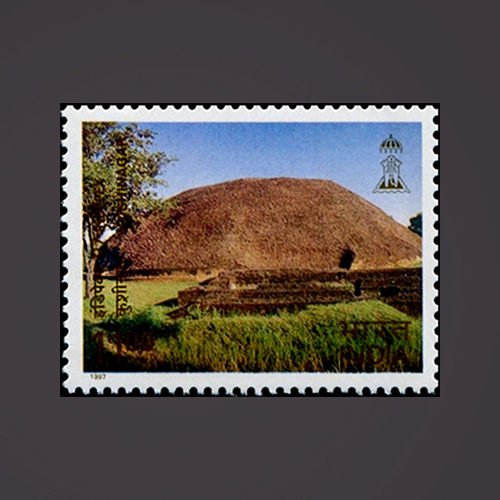
The Ramabhar Stupa is acknowledged as the cremation site of the Buddha and is situated adjacent to a pond known as Ramabhar. In #buddhist texts, this stupa is referred to as Mukutabandhana Chaitya. Excavations by Hiranand Shastri in 1910 revealed the remains of a brick floor, wall corners in the center, and part of a circular drum, which has a diameter of 34.14 meters. In addition to this prominent stupa, the complex features several votive stupas and the remnants of Buddhist vihars.
Numerous clay seals, ornamental bricks, and other artifacts have been uncovered through excavation efforts. The findings also include #copper coins from the #Kushan period, #silver coins from #Kumaragupta, and other copper coins.
Moreover, the third stamp issued by India Post to commemorate the 'INDEPEX-97' #International #stamp #exhibitions features the Ramabhar Stupa and carries a face value of Rs 11. For further information regarding previous issues, please refer to :
This Post
This Post
Latest News
-
Mithuna (Couple) Type Coin from the Post-Mauryan Ujjaini Region
2026-11-17 TueContinuing our exploration of the distinctive coinage of the Post-Mauryan Ujjaini region, let us ...
-
Lord Shiva Standing Type Copper Coin of the Ujjaini Region from Post-Mauryan Period
2026-11-17 TueThe Post-Mauryan period (200 BCE–300 CE) witnessed the emergence of several regional kingdoms, ...
-
Rare Silver 1½ Shana Punch-Marked Coin of Panchala Janapada
2026-11-16 MonThe Panchala Janapada was one of the sixteen Mahajanapadas of ancient India, flourishing during t...
-
Earth God on Panchala Copper Coin of King Bhumimitra
2026-11-16 MonThe ancient kingdom of Panchala was one of the prominent Mahajanapadas of northern India. Located...
-
Silver Punch-Marked Coin of Vidarbha Janapada – Melghat Region
2026-11-13 FriThe emergence of Janapadas during the ancient period marked an important phase in India's politic...