
Fascinating Archaeological Facts on Postage Stamps - 40
2025-05-30 Fri
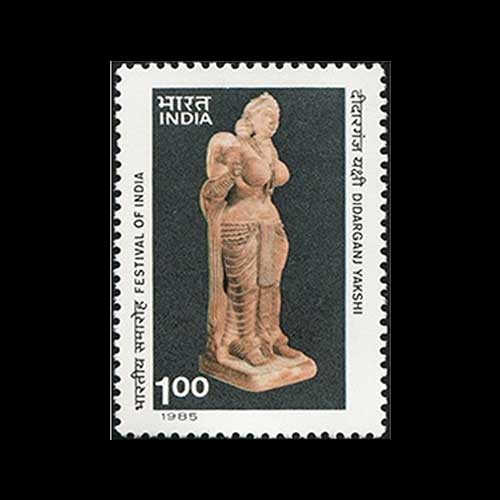
The History of sculptural art in India traces its roots back to the Harappan Civilization, which produced intricate terracotta and Bronze figurines. Over time, distinct schools of art and sculpture emerged, notably in Gandhara, Mathura, and amaravati.One of the most exemplary pieces from early Indian #stone sculpture is the Didarganj Yakshi, also referred to as the Didarganj Chauri Bearer. This life-size sculpture, crafted from Chunar stone and measuring 5 feet 2 inches in height, was discovered in 1917, following erosion caused by the Ganga River at Didarganj Kadam Basul near Patna, Bihar. The sculpture exhibits a meticulous polishing technique that imparts a lustrous effect to its surface.
The age of the Didarganj Yakshi has been a subject of scholarly debate. Earlier assessments placed its origin in the 3rd century BCE, while more contemporary research suggests a timeframe in the 1st century CE. Based on its artistic technique, polish, and surface ornamentation, it is generally associated with the Mauryan period. However, some historians propose that its attractive form and prominent anklets may connect it to the Kushana period, making precise dating challenging due to the lack of associated artifacts from the same site.
Additionally, there has been ongoing discourse regarding the identity of the sculpture. Throughout the 20th century, it has been identified alternately as a goddess, a yakshi (a female nature deity), or a ganika (a female royal attendant). This ambiguity arises, in part, from its depiction with a chowrie (fly-whisk), a common attribute shared by both yakshis and ganikas.
On June 13, 1985, India Post commemorated the Didarganj Yakshi by issuing a stamp valued at Re 1, aligned with the theme of the 'Festival of India.' In 1986, the statue garnered public attention when its nose was inadvertently damaged during its transportation to the Smithsonian Institution and the National Gallery of Art in #Washington, D.C., #USA. Currently, the sculpture is housed at the Bihar Museum.
Latest News
-
The Elephant on an Indo-Greek Silver Drachm of Apollodotus I
2026-09-22 TueElephants were not just an important part of Indian heritage and religious traditions; they also ...
-
Gajalakshmi Flanked by Elephants on a Post-Mauryan Ujjaini Copper Coin
2026-09-22 TueThe association between Gajalakshmi and elephants is one of the most enduring motifs in Indian re...
-
Elephant Head on a Bronze Coin of Indo-Scythian King Maues
2026-09-21 MonAs the eighth day of Ganesh Utsav is celebrated, the elephant once again provides a fascinating l...
-
A Remarkable Elephant-and-Lion Standard on Vrishni Coinage
2026-09-21 MonAs Ganesh Utsav continues, the elephant once again offers a fascinating doorway into India’s an...
-
Elephant and Lion on a Cooch Behar Royal Coin
2026-09-19 SatThe elephant occupies a distinctive place in the cultural traditions of eastern India, particular...