
2026-09-21 Mon
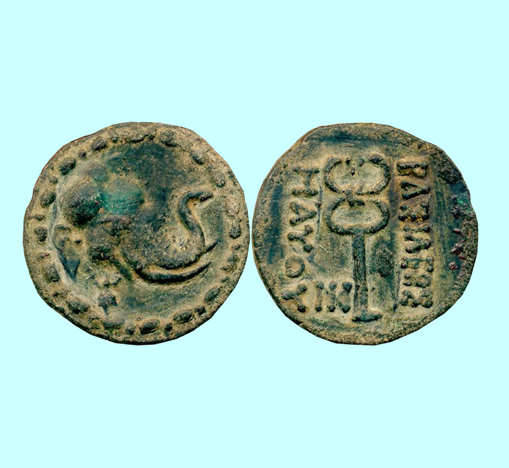
As the eighth day of Ganesh Utsav is celebrated, the elephant once again provides a fascinating link between India’s living traditions and its ancient numismatic heritage. Revered through Lord Ganesha, the elephant has long represented strength, wisdom and auspiciousness in Indian culture. Its importance, however, extends far beyond religious traditions, as the animal also appears prominently on some of the earliest coinages of the north-western Indian subcontinent. A remarkable example is this bronze coin of Maues, an Indo-Scythian ruler, featuring the head of an elephant on its obverse.
Maues, one of the earliest known Indo-Scythian kings, established his power across parts of the north-western Indian subcontinent during the 1st century BCE. His coinage reflects the complex cultural environment of the region, combining Scythian political traditions with artistic and monetary conventions inherited from the earlier Indo-Greek kingdoms. His coins were struck in several metals and at different centres, including Taxila, and frequently incorporated Greek legends and imagery. The present bronze coin, weighing 9.80 g, is associated with Taxila. It belongs to a distinctive series in which an elephant's head facing right occupies the obverse.
The elephant is the most striking feature of the obverse. Its use on the coin is particularly interesting because elephant imagery had already formed part of the artistic and monetary vocabulary of the Taxila region before and during the Indo-Greek period. Encyclopaedia Iranica notes that animal types, including the elephant, were prominent among the bronze issues of Maues in the Taxila province and had appeared on the city's coinage even before the Greek occupation.
The reverse presents an equally fascinating combination of Greek writing and symbolism. At its centre is a caduceus, the staff entwined by two serpents, accompanied by a monogram to the left. Around it appears the Bactrian/Greek legend, “BASILEOS MAYOY”. The legend translates essentially as “of King Maues”. The use of Greek script and the title Basileos—“king”—demonstrates the continued influence of the Hellenistic monetary tradition in the north-west even under Indo-Scythian rule.
On the eighth day of Ganesh Utsav, this ancient bronze coin offers a beautiful reminder that the elephant has been represented in India's artistic and numismatic traditions for centuries. From the sacred and cultural symbolism associated with Ganesha to the elephant appearing on the coinage of an Indo-Scythian king, its enduring presence demonstrates the remarkable continuity and diversity of elephant imagery in South Asian heritage.
-
A Remarkable Elephant-and-Lion Standard on Vrishni Coinage
2026-09-21 Mon -
Elephant and Lion on a Cooch Behar Royal Coin
2026-09-19 Sat -
Gaja-Sardula: The Lion and Elephant on a Vijayanagara Coin
2026-09-19 Sat -
Elephant Featured on a Silver Punch Marked Karshapana
2026-09-18 Fri -
Elephant and Garuda: Symbols of Power on a Silver Dramma of Rashtrakutas
2026-09-18 Fri