
2026-09-19 Sat
The elephant occupies a distinctive place in the cultural traditions of eastern India, particularly in Bengal and the regions adjoining Assam. Revered in Hindu tradition through Lord Ganesha, the elephant is also associated with royal processions, temples and ceremonial traditions. In Cooch Behar, elephants were closely connected with the pageantry of the former Koch royal court; for instance, official accounts of the historic Ratha-yatra describe processions headed by beautifully decorated elephants. This enduring association of the elephant with grandeur, strength and royalty finds a fascinating expression on the coinage of the princely state of Cooch Behar.
The Koch rulers of Cooch Behar issued a distinctive series of Narayani coins, named after the royal name Narayan. By the late nineteenth and early twentieth centuries, however, British Indian currency had become the principal circulating medium in the state, and Cooch Behar coinage was largely restricted to ceremonial issues associated with the accession or coronation of its rulers.
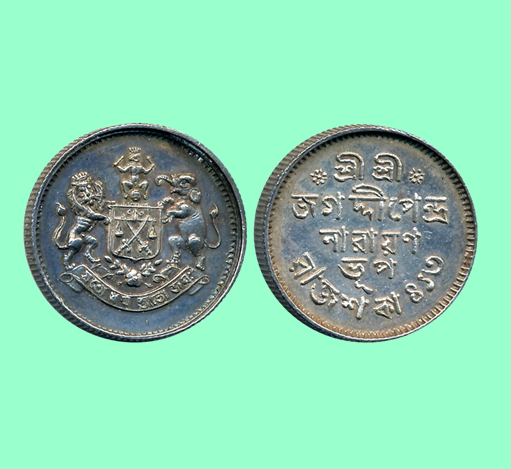
This Silver Ceremonial Nazarana ½ Rupee, weighing 5.66 g, belongs to the reign of Maharaja Jagaddipendra Narayan, who succeeded to the throne of Cooch Behar in 1922. The coin is dated Koch Rajsaka 413, corresponding to AD 1923. Jagaddipendra Narayan ruled Cooch Behar for much of the twentieth century, from 1922 until 1949.
The obverse presents the impressive Coat of Arms of Cooch Behar, supported on either side by a lion and an elephant. Beneath the arms appears the name “Grish”, associated with the die-maker of the earlier twentieth-century Cooch Behar issues.
The royal arms themselves contain several symbolic elements, including a shield, crossed swords, a balance and a crest surmounted by Hanuman, while the state motto “Yato Dharma Stato Jaya”—“Where there is virtue, there is victory”—appears on the associated heraldic design.
The reverse carries the Bengali legend, “Sri Sri / Jagaddipendra / Narayana / Bhup / Raja Saka 413” The inscription identifies the ruler and records the Cooch Behar era date. The use of Bengali script reflects the regional character of the princely state and gives the coin an additional connection to the cultural landscape of northern Bengal.
-
Gaja-Sardula: The Lion and Elephant on a Vijayanagara Coin
2026-09-19 Sat -
Elephant Featured on a Silver Punch Marked Karshapana
2026-09-18 Fri -
Elephant and Garuda: Symbols of Power on a Silver Dramma of Rashtrakutas
2026-09-18 Fri -
An Elephant depicted on the Copper Thira Cash of Travancore
2026-09-17 Thu -
Two Elephants Flank the Royal Emblem on a Coin of Rama Varma V of Travancore
2026-09-17 Thu