
2026-09-22 Tue
The association between Gajalakshmi and elephants is one of the most enduring motifs in Indian religious and artistic traditions. Gajalakshmi, the auspicious form of Goddess Lakshmi, is conventionally represented with two elephants standing on either side of her and performing abhisheka, or ritual bathing, by pouring water over her. The elephants are associated with water, rain, fertility, abundance and royal authority, while Lakshmi represents prosperity and auspiciousness. This imagery appears in Indian art from at least the early centuries BCE, including at sites such as Bharhut, Sanchi and Pitalkhora.
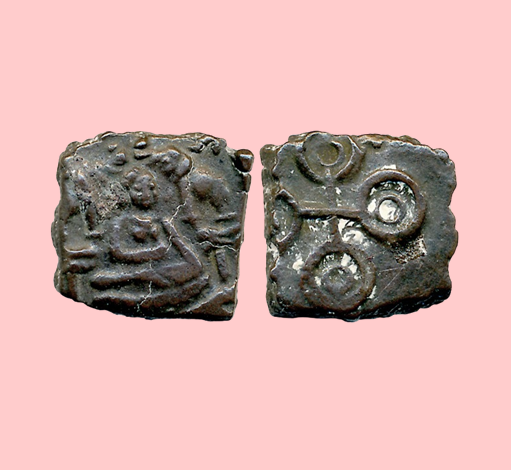
The beautiful Gajalakshmi motif also found its way onto the coinage of ancient India. An intriguing example is this uninscribed copper coin of the Post-Mauryan period from the Ujjaini region, weighing 4.27 grams. Its imagery combines the auspicious figure of Lakshmi with one of the most distinctive symbols associated with the ancient city of Ujjain.
On the obverse, Goddess Lakshmi is depicted seated cross-legged, with two elephants positioned on either side, their trunks raised as they perform the ceremonial bathing or abhisheka of the goddess. Two fish are shown below Lakshmi, adding another aquatic element to the composition.
The reverse carries the characteristic Ujjaini symbol, represented here in its double-orb form. The symbol, commonly associated with the Ujjain region, is among the most recognisable devices of ancient Malwa-Ujjain coinage. Ujjain was an important urban centre of ancient Avanti and the Malwa region, and its coinage frequently employed distinctive symbols rather than lengthy legends.
-
The Elephant on an Indo-Greek Silver Drachm of Apollodotus I
2026-09-22 TueElephants were not just an important part of Indian heritage and religious traditions; they also ...
-
Elephant Head on a Bronze Coin of Indo-Scythian King Maues
2026-09-21 MonAs the eighth day of Ganesh Utsav is celebrated, the elephant once again provides a fascinating l...
-
A Remarkable Elephant-and-Lion Standard on Vrishni Coinage
2026-09-21 MonAs Ganesh Utsav continues, the elephant once again offers a fascinating doorway into India’s an...
-
Elephant and Lion on a Cooch Behar Royal Coin
2026-09-19 SatThe elephant occupies a distinctive place in the cultural traditions of eastern India, particular...
-
Gaja-Sardula: The Lion and Elephant on a Vijayanagara Coin
2026-09-19 SatOngoing festive celebrations of Ganpati, the powerful symbolism of the elephant takes on a specia...