
2026-09-22 Tue
Elephants were not just an important part of Indian heritage and religious traditions; they also held a place in the cultural world of the Greeks and the wider Hellenistic world. Following the expansion of Greek power into the Indian subcontinent, the elephant became an especially significant image on the coinage of the Indo-Greek rulers. It could evoke Indian traditions and royal power, while its presence on coins issued by a Greek-speaking ruler illustrates the cultural interaction that characterised the Indo-Greek kingdoms. The precise symbolism of the elephant on Apollodotus I's coins, however, remains debated.
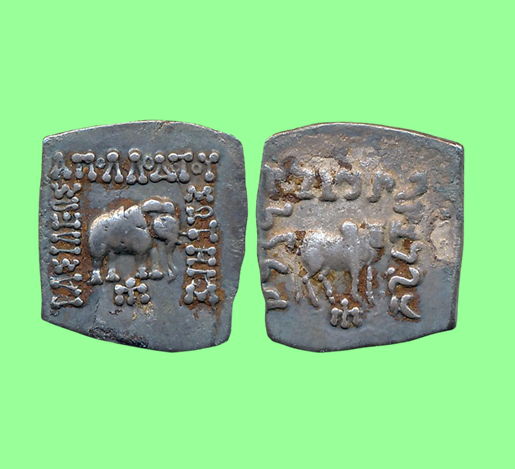
This silver square drachm of Apollodotus I, weighing 2.35 grams, is a fine example of the bilingual coinage of the Indo-Greek period. Apollodotus I was one of the important Indo-Greek rulers of the second century BCE. His coinage is particularly notable for combining Greek and Kharoshthi inscriptions, reflecting the multicultural environment in which Indo-Greek rulers exercised authority. Examples of his bilingual silver coinage are generally dated to around the mid-second century BCE, although exact chronological attributions vary among references.
The obverse features a powerful elephant standing or advancing to the right, with a monogram below. Surrounding the animal is the Greek legend, BASILEOS APOLLODOTOU SOTEROS meaning “Of King Apollodotus the Saviour.” The use of the Greek language and royal title reflects the Hellenistic political tradition, while the Indian elephant introduces a distinctly local visual element.
The elephant has generated considerable discussion among historians and numismatists. One interpretation associates it with Taxila, an important centre within the Indo-Greek sphere. Another connects it with the Buddhist tradition of Queen Maya's dream, in which a white elephant is associated with the conception of the Buddha. Since Buddhism was an important religious tradition in the regions where Indo-Greek rulers circulated their coinage, this interpretation has attracted scholarly attention. These explanations should nevertheless be regarded as interpretations rather than established facts, as the surviving evidence does not provide a definitive explanation of the elephant's intended meaning.
The reverse depicts a humped bull, or zebu, standing to the right, accompanied by another monogram. Around it appears the Kharoshthi legend, Maharajasa Apaladatasa Tratarasa which corresponds to the Greek legend and conveys the sense “Of the Great King Apollodotus the Saviour.” The use of Kharoshthi on the reverse was particularly significant in the Indian context, making the royal message accessible within the linguistic and administrative environment of the northwestern subcontinent.
The bull, like the elephant, has also been interpreted symbolically. It may have had a religious or regional significance in the Indian cultural context; some interpretations associate the humped bull with Nandi and Shiva, while other explanations have proposed a geographical or local association. The presence of animal imagery on both sides therefore appears to have been more meaningful than merely decorative, although the precise intentions behind these types remain uncertain.
-
Gajalakshmi Flanked by Elephants on a Post-Mauryan Ujjaini Copper Coin
2026-09-22 TueThe association between Gajalakshmi and elephants is one of the most enduring motifs in Indian re...
-
Elephant Head on a Bronze Coin of Indo-Scythian King Maues
2026-09-21 MonAs the eighth day of Ganesh Utsav is celebrated, the elephant once again provides a fascinating l...
-
A Remarkable Elephant-and-Lion Standard on Vrishni Coinage
2026-09-21 MonAs Ganesh Utsav continues, the elephant once again offers a fascinating doorway into India’s an...
-
Elephant and Lion on a Cooch Behar Royal Coin
2026-09-19 SatThe elephant occupies a distinctive place in the cultural traditions of eastern India, particular...
-
Gaja-Sardula: The Lion and Elephant on a Vijayanagara Coin
2026-09-19 SatOngoing festive celebrations of Ganpati, the powerful symbolism of the elephant takes on a specia...