
Fascinating Archaeological Facts on Postage Stamps - 20
2025-05-06 Tue
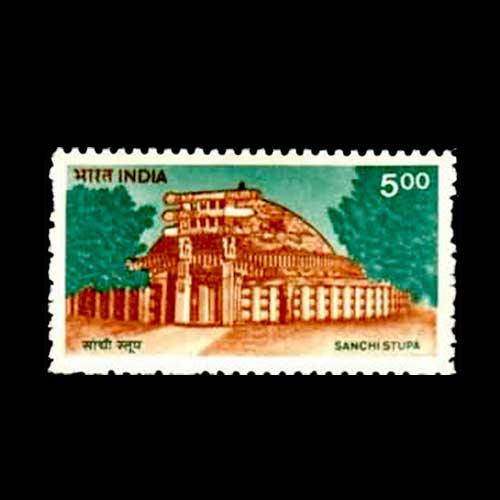
Emperor ashoka commissioned the Construction of several stupas and monuments to spread and sustain Buddhism throughout the Indian subcontinent, and beyond in South-East Asia. Ashoka had marital relations with the region of Vidisha in Madhya Pradesh. The Great Stupa at Sanchi near Vidisha stands out as one of the most important Buddhist structures. This UNESCO World Heritage Site was established in the 3rd century BCE and is recognized as the oldest Stone structure in India. It contains a Central chamber that houses the relics of Lord Buddha and his chief disciples, and key figures in spreading Buddhism - Sariputta (Shariputra) and Moggallana (Maudgalyayana).Stupas are dome-shaped structures used as Buddhist shrines, primarily for meditation and housing relics of the Buddha or other significant Figures. Originating in ancient India, they symbolize the Buddha's enlightened mind and the path to Nirvana. Architecturally, they typically feature a hemispherical dome, a square base, and a spire, with symbolic elements like the harmika (platform) and chhatra (umbrella) representing spiritual stages.
The Great Stupa is believed to have served as a vital religious center from the 3rd century BCE to the 13th century CE. Initially constructed under Ashoka's reign, the stupa has undergone numerous expansions over the centuries. Its dome reaches a height of approximately 16 meters and has a diameter of 36 meters. During the Shunga dynasty, the structure was enlarged, doubling its size and incorporating sandstone slabs into the mound's covering. Additional features, including the vedika, pradakshina, and harmika, were included during this period.
The four cardinal points of the stupa are adorned with intricately carved rock gateways, or toranas, created during the #Satavahana period. These toranas depict significant scenes from the life of Buddha and the history of Buddhism, with inscriptions in #Brahmi honoring the individuals who contributed to their construction (For more information refer to https://x.com/MintageWorld/status/1908440610383573178)
Further enhancements, such as a Buddhist temple, a lion pillar, and a victory inscription from Chandragupta II, were added during the Gupta period.
On April 4, 1994, #India Post issued a definitive stamp featuring the Sanchi Stupa, valued at Rs 5, highlighting this remarkable surviving wonder of ancient India!
Latest News
-
The Elephant on an Indo-Greek Silver Drachm of Apollodotus I
2026-09-22 TueElephants were not just an important part of Indian heritage and religious traditions; they also ...
-
Gajalakshmi Flanked by Elephants on a Post-Mauryan Ujjaini Copper Coin
2026-09-22 TueThe association between Gajalakshmi and elephants is one of the most enduring motifs in Indian re...
-
Elephant Head on a Bronze Coin of Indo-Scythian King Maues
2026-09-21 MonAs the eighth day of Ganesh Utsav is celebrated, the elephant once again provides a fascinating l...
-
A Remarkable Elephant-and-Lion Standard on Vrishni Coinage
2026-09-21 MonAs Ganesh Utsav continues, the elephant once again offers a fascinating doorway into India’s an...
-
Elephant and Lion on a Cooch Behar Royal Coin
2026-09-19 SatThe elephant occupies a distinctive place in the cultural traditions of eastern India, particular...