
2026-07-20 Mon
An important part of Indian numismatics is coinage of Lead Dynasties. Chandravalli and Brahmagiri, located in Chitradurga (central Karnataka), are important prehistoric and early historic archaeological sites within the Krishna River basin. The Satavahan ruler Satarkarni and his wife Naganika calls herself daughter of Kalalaya Maharathi (महारठी ). The rulers of this lineage used the title Maharathi, which generally referred to powerful feudatories or semi-independent chiefs.
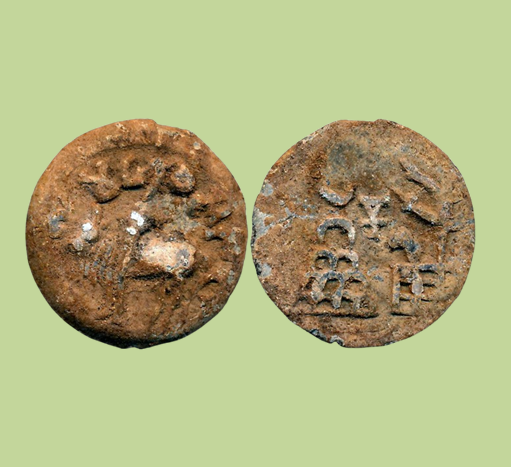
Numismatic evidence from the region highlights the existence of a rare series of lead coins attributed to a ruling lineage known as the Sidaka or Sadakana family. This clan is believed to have governed the Brahmagiri–Chandravalli area. One of the notable rulers was Kalalaya also referred to as Sadakana Kalalaya, who issued coins bearing the image of a humped bull along with Brahmi inscriptions.
Although they were often associated with, or subordinate to, the Satavahana (Andhra) dynasty, their issuance of independent coinage indicates a considerable degree of local autonomy. The Sidaka/Sadakana family appears to have been one of the prominent Maharathi lineages in the Chitradurga–Chandravalli region.
Coins from this group are highly valued by historians and collectors alike. They typically display a bull or symbolic motifs—such as a multi-arched hill surmounted by a crescent—on one side, while the other side carries a Prakrit legend in Brahmi script, often read as “Maharathisa Sadakana Kalalayas.” Additional figures, including a ruler named Venhukuta Maharathi, have also been identified through similar finds in the area.
The obverse of this particular coin shows a bull standing and facing left, surrounded by a Brahmi legend reading “Maharathisa Sidakanam…” The reverse features a symbolic composition: a ten-arched hill topped with a crescent, a tree-in-railing to the right, and a triangular-headed standard positioned between them.
P.S. (Excavations at some of the above mentioned locations have yielded a wide range of artifacts, including Roman antiquities and coins, suggesting active long-distance trade connections.)
-
The Elephant on an Indo-Greek Silver Drachm of Apollodotus I
2026-09-22 TueElephants were not just an important part of Indian heritage and religious traditions; they also ...
-
Gajalakshmi Flanked by Elephants on a Post-Mauryan Ujjaini Copper Coin
2026-09-22 TueThe association between Gajalakshmi and elephants is one of the most enduring motifs in Indian re...
-
Elephant Head on a Bronze Coin of Indo-Scythian King Maues
2026-09-21 MonAs the eighth day of Ganesh Utsav is celebrated, the elephant once again provides a fascinating l...
-
A Remarkable Elephant-and-Lion Standard on Vrishni Coinage
2026-09-21 MonAs Ganesh Utsav continues, the elephant once again offers a fascinating doorway into India’s an...
-
Elephant and Lion on a Cooch Behar Royal Coin
2026-09-19 SatThe elephant occupies a distinctive place in the cultural traditions of eastern India, particular...