
2026-07-18 Sat
The city state of Eran was positioned strategically at the intersection of major ancient trade routes connecting Pataliputra with Mathura, Ujjain, and the western seaports. It held considerable economic and political importance. As a result, control of the region shifted among several prominent Indian dynasties over time.
Eran was an important ancient town situated on the southern bank of the Bina River, in present-day Sagar district of Madhya Pradesh. It functioned as a prosperous fortified city, a significant minting center, one of the earliest known ancient mints. Eran later served as the capital of Airikina Vishaya—an administrative division during the Gupta period.
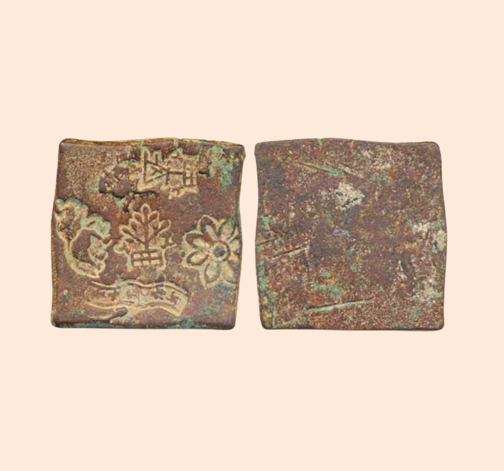
Alongside PMC (Punch Marked Coins) Eran mint is also known for introducing die-struck techniques. The above coin is many of the finest PMC example of city state of Era and these coins are considered among India's finest.
The Karshapana represents one of the earliest forms of standardized currency in ancient India. Some linguists suggest that the modern English word “cash” may ultimately derive from the Tamil word kasu which itself has links to the Sanskrit term karsha. Likewise fanam has a connection with the word pana.
Karshapanas were typically produced by punching a series of symbols onto flat pieces of silver or copper. Common motifs included the sun, six-armed symbols, arched hills, animals, rivers, and aquatic creatures. These marks helped identify the issuing authority and place of origin, aiding merchants and money changers in authentication.
Eran PMC comes with different motifs on the uniface flan. There are motifs of animals like Horse, Elephants, Turtles, Ducks, Turtles, and fishes. Interestingly fishes, turtle, and ducks are shown in a flowing river! Ujjaini symbol, Indradhvaja, tree, tree with railing and lotus flower etc are few other interesting motifs.
The above punch-marked copper square Karshapana, weighing approximately ~10g, features five distinct symbols on the obverse. These include a flowing river with fish and turtles at the bottom, an elephant walking to the right on the left side, a tree-in-railing at the center, an eight-petalled floral motif, and an inverted triangular fire altar within a railing at the top. The coin is uniface, with markings present only on one side.
-
The Elephant on an Indo-Greek Silver Drachm of Apollodotus I
2026-09-22 TueElephants were not just an important part of Indian heritage and religious traditions; they also ...
-
Gajalakshmi Flanked by Elephants on a Post-Mauryan Ujjaini Copper Coin
2026-09-22 TueThe association between Gajalakshmi and elephants is one of the most enduring motifs in Indian re...
-
Elephant Head on a Bronze Coin of Indo-Scythian King Maues
2026-09-21 MonAs the eighth day of Ganesh Utsav is celebrated, the elephant once again provides a fascinating l...
-
A Remarkable Elephant-and-Lion Standard on Vrishni Coinage
2026-09-21 MonAs Ganesh Utsav continues, the elephant once again offers a fascinating doorway into India’s an...
-
Elephant and Lion on a Cooch Behar Royal Coin
2026-09-19 SatThe elephant occupies a distinctive place in the cultural traditions of eastern India, particular...