
2026-07-20 Mon
The Mahatalavaras were influential feudal chiefs, provincial governors, and military commanders in ancient and early medieval Coastal Andhra / Telangana districts situated on fertile land between two mighty rivers – Godavari and Krishna, in the north and south respectively. They emerged prominently during the Satavahana period and continued to flourish under the Ikshvaku dynasty in the 3rd century CE. Serving directly under the ruling monarchs, they functioned as key administrative and military authorities while also acting as intermediaries between the central power and local governance.
Rather than representing a single ruling dynasty, the Mahatalavaras formed a class of powerful regional elites. They played a crucial role in maintaining stability and administration in Coastal Andhra during the transitional phase following the decline of the Satavahanas and before the rise of later regional kingdoms.
Their prominence reflects the decentralized political structure of ancient Andhra. While major dynasties such as the Satavahanas and Ikshvakus held overarching authority, day-to-day administration in the fertile coastal regions was largely managed by local chiefs like the Mahatalavaras.
Evidence from inscriptions and coinage highlights their economic and cultural significance. Their issues suggest active engagement in trade and agriculture, as well as patronage of regional traditions. The Mahatalavaras represent a localized administrative system that combined indigenous practices with elements of Prakrit and Sanskrit court culture. They exercised considerable autonomy, overseeing territories, collecting revenue, issuing coins, and, in some cases, forming alliances through marriage with ruling dynasties.
Epigraphic records indicate that the Pukiya clan was one of the prominent Mahatalavara lineages. They governed a region extending from Srisailam to the Bay of Bengal, particularly along the Gundlakamma River, covering parts of present-day Guntur and Prakasam districts.
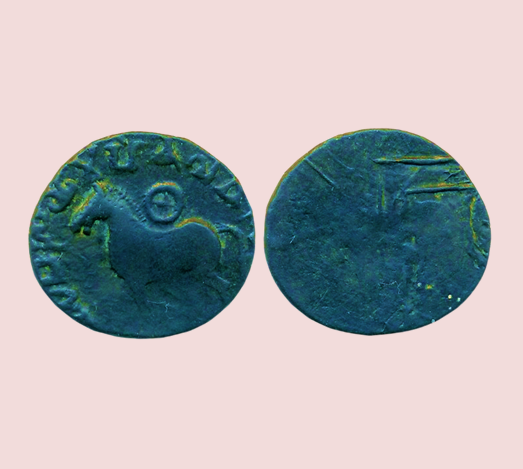
Numismatic discoveries from this region include distinctive lead and copper coins attributed to the Mahatalavaras. These coins commonly feature motifs such as horses, bulls, and symbols like the Srivatsa, reflecting their localized authority in the eastern Deccan. Such coins have been found at sites including Phanigiri, Kotalingala, Vinukonda, Chandavaram, and Peddabankuru. They typically bear Brahmi legends such as “Mahatalavarasa,” often accompanied by the name of the issuing authority.
The obverse of the coin depicts a horse facing left, with a circular symbol above and a surrounding Brahmi legend reading “...Sa Mahatalavara(sa).” The reverse shows a worn or partially obliterated arched-hill motif enclosed within a framed design.
-
The Elephant on an Indo-Greek Silver Drachm of Apollodotus I
2026-09-22 TueElephants were not just an important part of Indian heritage and religious traditions; they also ...
-
Gajalakshmi Flanked by Elephants on a Post-Mauryan Ujjaini Copper Coin
2026-09-22 TueThe association between Gajalakshmi and elephants is one of the most enduring motifs in Indian re...
-
Elephant Head on a Bronze Coin of Indo-Scythian King Maues
2026-09-21 MonAs the eighth day of Ganesh Utsav is celebrated, the elephant once again provides a fascinating l...
-
A Remarkable Elephant-and-Lion Standard on Vrishni Coinage
2026-09-21 MonAs Ganesh Utsav continues, the elephant once again offers a fascinating doorway into India’s an...
-
Elephant and Lion on a Cooch Behar Royal Coin
2026-09-19 SatThe elephant occupies a distinctive place in the cultural traditions of eastern India, particular...