
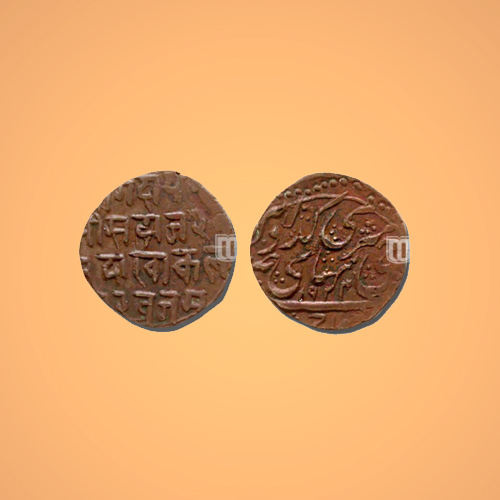
Devanagari and Persian Legends on Coin
2021-07-16 Fri
Ladakh was inhabited by Indo-Aryans of Mons and Dards according to Herodotus, Nearchus, Megasthenes, Pliny, Ptolemy and Puranas. During the 1st century AD, Ladakh was under Kushan rule. In the 2nd century, Buddhism was widespread in the eastern part of Ladakh while the Bon religion dominated the western part.Due to its topographical extent, it came under the influence of Tibet from the east and the Chinese from Central Asia in the 8th century. Control over Ladakh changed regularly from China to Tibet and vice versa. King Nyima-Gon was feudatory of the Tibetan empire who broke out from his original Tibet Empire and established the kingdom at Ladakh. This led to the migration of the Tibetan population to Ladakh and Buddhism philosophy flourished for the second time from the northwest side. He established his kingdom in the eastern side of present-day Ladakh.
The coin represents the unity of scripts as it has Devanagari and Persian legends together. The copper Paisa was issued by Dogras of Jammu in 1924 VikramSamvat at Ladakh mint.
Image Courtesy: Mintage World
Latest News
-
Elephant and Lion on a Copper Coin of the Sangam Cholas
2026-09-24 ThuThe elephant and lion were powerful animal symbols in the artistic and political traditions of an...
-
Ganesha and Shiva Together on a Coin of the Shiv Ganga Rajas
2026-09-25 FriOn Anant Chaturdashi, devotees bid farewell to Lord Ganesha with prayers and devotion, celebratin...
-
Elephant on a Punch-Marked Coin of the Vidarbha Janapada
2026-09-23 WedThe history of Indian coinage begins with the remarkable tradition of punch-marked coins, among t...
-
Gandabherunda and Four Elephants on a Gold Half Varaha of Achyutadevaraya
2026-09-23 WedThe Gandabherunda, the mythical two-headed bird of Indian tradition, is one of the most striking ...
-
The Elephant on an Indo-Greek Silver Drachm of Apollodotus I
2026-09-22 TueElephants were not just an important part of Indian heritage and religious traditions; they also ...