
Sayajirao Gaekwar’s Coin from Baroda Princely State
2021-05-04 Tue
The term ‘Baroda’ or native name ‘Vadodara’ traces roots in Sanskrit which can be understood by dividing it into Vat means Banyan tree and Oodara means stomach. In some references, Vadodara is also defined as the ‘heart of Banyan tree’.Gujarati poet, Premanand Bhatt mentioned other names of Baroda such as Virakshetra or Virawati, which means land of warriors. Early English travelers and merchants mentioned Brodera from which Baroda's name was derived. It was stretched over a large territory, across present-day Gujarat. It was divided into four parts- Kadi, Baroda, Navsari, and Amreli. Also, coastal areas such as Okhamadal and Kodinar were a part of the Baroda princely state.
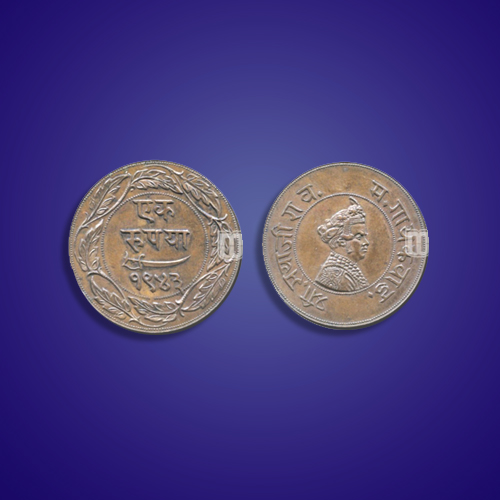
Copper rupee of Sayaji Rao III of Baroda (1875–1939), showing his portrait. This coin is dated 1943 in the Vikram era. The coin is minted in the name of Shri Sayajirao Gaekwar. The obverse of the coin has the effigy of turbaned Shri Sayajirao Gaekwar facing right with Devnagari legend. And the reverse shows denomination, date below and scimitar, within the wreath.
Latest News
-
Elephant and Lion on a Copper Coin of the Sangam Cholas
2026-09-24 ThuThe elephant and lion were powerful animal symbols in the artistic and political traditions of an...
-
Ganesha and Shiva Together on a Coin of the Shiv Ganga Rajas
2026-09-25 FriOn Anant Chaturdashi, devotees bid farewell to Lord Ganesha with prayers and devotion, celebratin...
-
Elephant on a Punch-Marked Coin of the Vidarbha Janapada
2026-09-23 WedThe history of Indian coinage begins with the remarkable tradition of punch-marked coins, among t...
-
Gandabherunda and Four Elephants on a Gold Half Varaha of Achyutadevaraya
2026-09-23 WedThe Gandabherunda, the mythical two-headed bird of Indian tradition, is one of the most striking ...
-
The Elephant on an Indo-Greek Silver Drachm of Apollodotus I
2026-09-22 TueElephants were not just an important part of Indian heritage and religious traditions; they also ...