
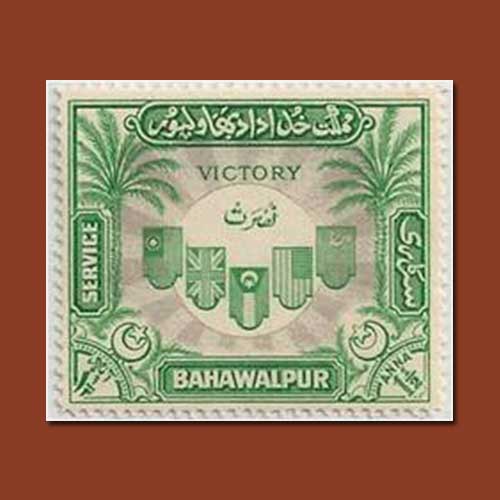
Green stamp of Bahawalpur
2020-09-28 Mon
The era of British India is a never ending process of analysing history not only from the perception of freedom struggle but also from the royal hierarchy of that period. The Princely State or the protectorates under British had their own coinage for ample amount of time but the circulation of British coins put a stop to it. Yet they allowed few of the Princely States to issue their own postal or revenue stamps within their state borders.One such example of this practice was the Princely State of Bahawalpur. This state used the postage stamp of British India until 1945 and after that they started issuing official stamps within the state. The first sets of stamps were inscribed with Urdu legend. These set of six stamps illustrated beautiful pictorial scenes with overprinted text ‘sarkari’ on it.
Later on, three stamp designs were issued in black colour too. This state issued at least 16 official stamps around 1945 to 1946 CE. This state also circulated an overprint stamp of King George VI. These all stamps were used to deliver mail within the state.
On 1st December 1947, this state joined the Dominion of Pakistan and started following the regular postal issues of the country.
Latest News
-
Elephant and Lion on a Copper Coin of the Sangam Cholas
2026-09-24 ThuThe elephant and lion were powerful animal symbols in the artistic and political traditions of an...
-
Ganesha and Shiva Together on a Coin of the Shiv Ganga Rajas
2026-09-25 FriOn Anant Chaturdashi, devotees bid farewell to Lord Ganesha with prayers and devotion, celebratin...
-
Elephant on a Punch-Marked Coin of the Vidarbha Janapada
2026-09-23 WedThe history of Indian coinage begins with the remarkable tradition of punch-marked coins, among t...
-
Gandabherunda and Four Elephants on a Gold Half Varaha of Achyutadevaraya
2026-09-23 WedThe Gandabherunda, the mythical two-headed bird of Indian tradition, is one of the most striking ...
-
The Elephant on an Indo-Greek Silver Drachm of Apollodotus I
2026-09-22 TueElephants were not just an important part of Indian heritage and religious traditions; they also ...