
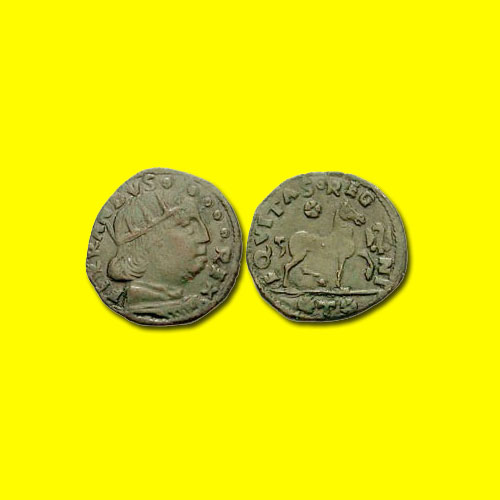
Cavallo of Ferdinand I of Naples
2020-06-02 Tue
Ferdinand I of Naples also known as Ferrante of Naples, was King of Naples from 27 June 1458 to 25 January 1494, succeeding Alfonso I and preceding Alfonso II.Don Ferrante was born on 2nd June 1423, in Spain, the illegitimate son of Alfonso V of Aragon. At the age of 35, in 1458, he inherited the kingdom of Naples from his father. At that time, it had the most powerful navy in the western part of the Mediterranean. During his reign, the kingdom was under steady attack not only from external powers such as the Turks, the French, the Republic of Venice, and the Papacy but also by the local barons.
Ferdinand was gifted with great courage and real political ability, but his method of government was vicious and disastrous. His financial administration was based on oppressive and dishonest monopolies. The Cavallo was a copper coin of southern Italy in the Renaissance. It was minted for the first time by King Ferdinand I of Naples in 1472. It gained its name from the figure of a horse on the reverse.
Image Source: Wikipedia.org
Latest News
-
An Interesting Five-Symbols on Punch-Marked Copper Square Karshapana of Eran
2026-11-18 WedThe ancient region of Eran, situated in present-day Madhya Pradesh, was an important centre of ea...
-
Sacred Symbols and Natural Motifs on Post-Mauryan Coinage of the Eran-Vidisha Region
2026-11-18 WedThe decline of the Mauryan Empire in the second century BCE marked the emergence of several regio...
-
Mithuna (Couple) Type Coin from the Post-Mauryan Ujjaini Region
2026-11-17 TueContinuing our exploration of the distinctive coinage of the Post-Mauryan Ujjaini region, let us ...
-
Lord Shiva Standing Type Copper Coin of the Ujjaini Region from Post-Mauryan Period
2026-11-17 TueThe Post-Mauryan period (200 BCE–300 CE) witnessed the emergence of several regional kingdoms, ...
-
Rare Silver 1½ Shana Punch-Marked Coin of Panchala Janapada
2026-11-16 MonThe Panchala Janapada was one of the sixteen Mahajanapadas of ancient India, flourishing during t...