
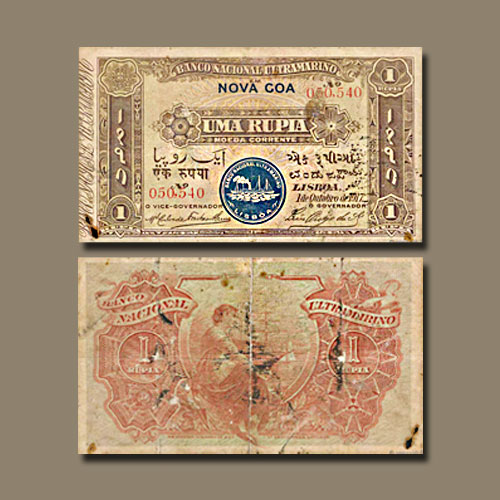
The Indo-Portuguese One rupee note
2020-02-19 Wed
In 1498, the Portuguese were the first Europeans to land on the Indian shores. They remained in power for nearly two centuries in India but due to the rise of the British East India Company, their dominion was confined to Goa and another region on the west coast of India.Portuguese issued the first one rupee note in 1917, written as “Uma Rupia”. It was the second issue of ‘Banco Nacional Ultramarino’ meaning Overseas National Bank of New Goa. It was printed in London by Bradbury Wilkinson & Co. Ltd. This issue of one rupee note had two types.
The first type consisted of a blue seal of Nova Goa on the obverse, which is called as the blue type. The reverse of which was reddish in color. The second type consisted of a Brownish seal of Nova Goa on the obverse, which is called as the brown type with Brownish Maroon color in reverse.
The reverse side of these two notes depicts Ornamental Guilloche panel on either side of a maiden resting on an anchor with ship and water in the background.
Image Source: https://www.cgbfr.com
Latest News
-
Twin Fishes and Bull on a Pandya Copper Coin
2026-09-28 MonThe Pandyas were one of the three great Tamil dynasties of the Sangam age, alongside the Cheras a...
-
Sangam-Age Chola Copper Coin with Lion/Tiger, Elephant and Auspicious Symbols
2026-09-28 MonThe Cholas were one of the three major Tamil dynasties of the Sangam age, alongside the Cheras an...
-
Elephant and Lion on a Copper Coin of the Sangam Cholas
2026-09-24 ThuThe elephant and lion were powerful animal symbols in the artistic and political traditions of an...
-
Ganesha and Shiva Together on a Coin of the Shiv Ganga Rajas
2026-09-25 FriOn Anant Chaturdashi, devotees bid farewell to Lord Ganesha with prayers and devotion, celebratin...
-
Elephant on a Punch-Marked Coin of the Vidarbha Janapada
2026-09-23 WedThe history of Indian coinage begins with the remarkable tradition of punch-marked coins, among t...