
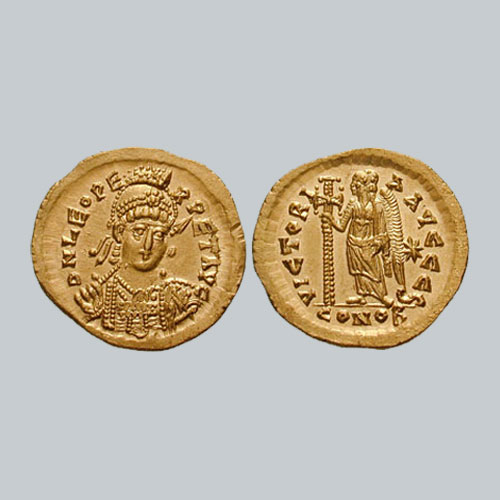
Gold Solidus of Leo I the Thracian
2020-02-06 Thu
7th February is a day when in the year 457 Leo I the Thracian becomes Emperor of the Byzantine Empire. Leo rules the Eastern Empire for nearly 20 years from 457 to 474 AD.He was born in Thracia to a Thraco Roman family. He began his career in the Roman army, becomes a protege of General Asper. Leo was the last of a series of emperors placed on the throne by Aspar, who expected to use him as a puppet ruler. Leo's coronation as emperor on 7 February 457 was the first known to involve the Patriarch of Constantinople.
During the reign, he made many bravely ambitious moves that expanded the Eastern Roman Empire. He is notable for being the first Eastern Emperor to legislate in Greek rather than Latin.
He issued gold and silver coins. Depicted here is a gold solidus which issued during his reign. The obverse of a coin depicts the Bust of King wearing a pearl diadem, helmet and cuirass. Spear in right hand over right shoulder, shield decorated with horseman riding down enemy in left hand. The reverse depicted the Victory standing left with long cross, star in right field.
Image Source: https://en.wikipedia.org/
Latest News
-
Goddess Lakshmi in Padmasana Posture on a Rare Kakatiya Gold Gadyana Coin
2026-11-19 ThuThe Kakatiya dynasty was an important ruling power in the Deccan, with its influence centred arou...
-
Chalukyan-style Temple on Gold Gadyana
2026-11-19 ThuThe Chalukyas of Kalyani, also known as the Western Chalukyas, were an influential ruling dynasty...
-
An Interesting Five-Symbols on Punch-Marked Copper Square Karshapana of Eran
2026-11-18 WedThe ancient region of Eran, situated in present-day Madhya Pradesh, was an important centre of ea...
-
Sacred Symbols and Natural Motifs on Post-Mauryan Coinage of the Eran-Vidisha Region
2026-11-18 WedThe decline of the Mauryan Empire in the second century BCE marked the emergence of several regio...
-
Mithuna (Couple) Type Coin from the Post-Mauryan Ujjaini Region
2026-11-17 TueContinuing our exploration of the distinctive coinage of the Post-Mauryan Ujjaini region, let us ...