
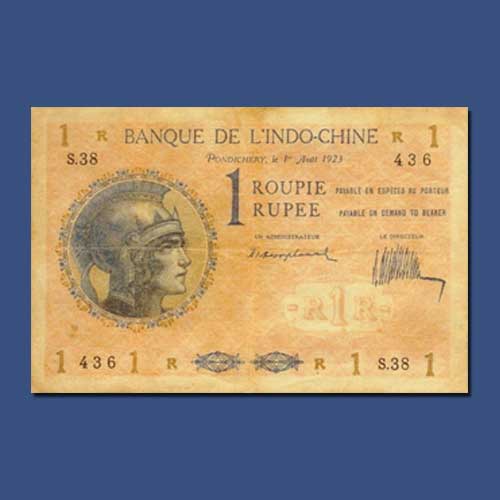
Indo-French One rupee note
2020-01-17 Fri
French started having in India after the establishment of the French East India Company. They establish their monopoly in southern Indian politics and trade around 1750-1770s. Eventually, the war with England and political tension due to the French revolution saw the decline in French dominion and influence in the Indian. Hence, the French settlement confinement to the east coast of India and its center was Pondicherry.The banknote issued in the colonies was managed by the ‘Banque de Indochine’ from Paris. Eventually, an agreement between ‘Le Comptoir D’Escompte d’Escomte de’ Paris and ‘Credit Industrial et Commercial’ set a bank to operate the circulation of money in Cochin, china and other French Indian territories.
In 1877, a branch office of this bank was also opened in Pondicherry in the Oriental Bank Building. This branch was responsible for issuing French notes in India. The entire banknote issued by Banque de Indochine’ from 1876 to World War I, was printed by the Bank of France.
The first ‘one roupie’ or ‘rupee note’ was circulated in 1920 and was signed by two signatories as the Administrators in French colonies. The monetary system compares to Indian circulation was different. The money in French-occupied India was based on the silver coinage, the rupee.
The above-shown note was bought in circulation in 1924 but the date illustrated in the note is 1923. This note also contains two signatories, but their designation is the Director in French India. The later issues of one rupee also depict two signatories. The designation of these signatories was General in the French Indian colonies. The promise text was also printed on the one rupee notes of Indo-French currency.
The vignette of this one rupee note was designed by Charles Walhain. The vignette window of these notes illustrated Marianne. She has been the symbol of France since the French revolution of 1789-99. Marianne is the insignia of the Republic of strong, proud people. During wartime, she is a more aggressive woman in battle dress.
The Banknote issued by Banque de l’indochine ceased on 1st November 1954, when the Indian currency became legal tender after the incorporation of French colonies into the Independent Union of India.
To know more about other one rupee not click here
Latest News
-
Twin Fishes and Bull on a Pandya Copper Coin
2026-09-28 MonThe Pandyas were one of the three great Tamil dynasties of the Sangam age, alongside the Cheras a...
-
Sangam-Age Chola Copper Coin with Lion/Tiger, Elephant and Auspicious Symbols
2026-09-28 MonThe Cholas were one of the three major Tamil dynasties of the Sangam age, alongside the Cheras an...
-
Elephant and Lion on a Copper Coin of the Sangam Cholas
2026-09-24 ThuThe elephant and lion were powerful animal symbols in the artistic and political traditions of an...
-
Ganesha and Shiva Together on a Coin of the Shiv Ganga Rajas
2026-09-25 FriOn Anant Chaturdashi, devotees bid farewell to Lord Ganesha with prayers and devotion, celebratin...
-
Elephant on a Punch-Marked Coin of the Vidarbha Janapada
2026-09-23 WedThe history of Indian coinage begins with the remarkable tradition of punch-marked coins, among t...