
Independent Kingdoms Jaintiapur Silver Tanka
2019-10-17 Thu
The word ‘Jaintia’ is derived from the shrine of Jayanti Devi or Jainteswari, an incarnation of Hindu goddess Durga. Some people also called it as Pnar, also known as Jaintia, a sub tribal group of Khasi Tribe in Meghalaya, India.Today the kingdom of Jaintia is situated in present-day Bangladesh and North-East India. Later it was annexed by the British East India Company in the year 1835. The origin of this kingdom is unknown, but the people of Jaintia share culture from the Megalithic Phase. A megalith is a large stone that has been used to construct a structure or monument, either alone or together with other stones.
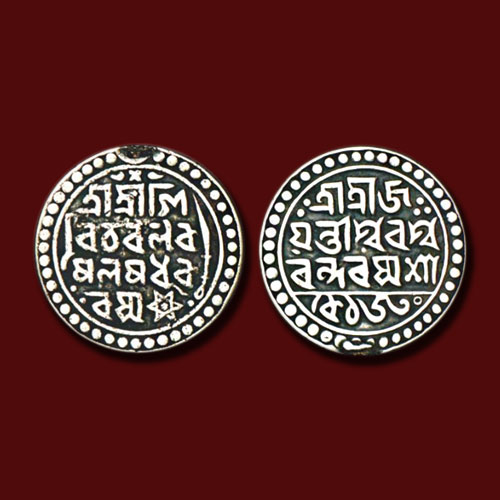
This silver tanka was issued by king Jayanarayan of the Jaintiapur Kingdom in the Saka Year 1630. The weight of this silver tanka is around 9.19g. The obverse of this coin is inscribed as ‘Sri Sri/Va Charana Ka/Mala Madhu Karasya. The reverse of this coin is inscribed as ‘Sri Sri Ja/Yantipura Pu/Randarasya Sa/ Ke 1630.
Image Courtesy: Classical Numismatic Gallery
Latest News
-
Vikrama Pandya and the “Konerinmai-kondan” Copper Half Cash
2026-09-29 TueFor centuries, the Pandyas played a significant role in the history of southern India, forming on...
-
Narasimha on a Copper Kasu of the Kongu Cheras
2026-09-29 TueThe Chera dynasty was one of the three great ruling houses of ancient Tamilakam, alongside the Ch...
-
Twin Fishes and Bull on a Pandya Copper Coin
2026-09-28 MonThe Pandyas were one of the three great Tamil dynasties of the Sangam age, alongside the Cheras a...
-
Sangam-Age Chola Copper Coin with Lion/Tiger, Elephant and Auspicious Symbols
2026-09-28 MonThe Cholas were one of the three major Tamil dynasties of the Sangam age, alongside the Cheras an...
-
Elephant and Lion on a Copper Coin of the Sangam Cholas
2026-09-24 ThuThe elephant and lion were powerful animal symbols in the artistic and political traditions of an...