
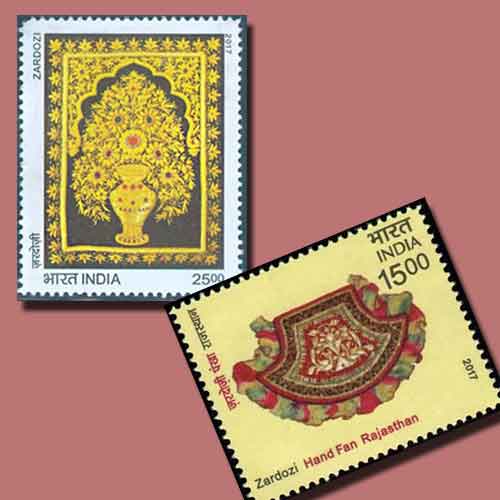
Zardozi
2018-04-10 Tue
Zardozi embroidery is beautiful metal embroidery, which once used to embellish the attire of the kings and the royals in India. It was also used to adorn walls of the royal tents, scabbards, wall hangings and the paraphernalia of regal elephants and horses.The Persian word Zardozi means sewing with a gold thread (‘Zar’ means gold) it is said that the art form was brought to India by the Mughal rulers. The craft reached its zenith during the period of Akbar (a 16th-century Mughal emperor). However, by the time of Aurangzeb’s period (the 6th Mughal emperor), it registered a decline due to lack of royal patronage.
The process of doing Zardozi embroidery starts with the craftsmen sitting cross-legged around the Addaa, the wooden framework, with their tools. The tools include curved hooks, needles, salmaa pieces (gold wires), sitaaras (metal stars), round-sequins, glass & plastic beads, dabkaa (thread) and kasab (thread). The second step in the process is to trace out the design on the cloth, if possible fabrics like silk, satin, velvet, etc. The fabric is then stretched over the wooden frame and the embroidery work begins. A needle is used to pull out each zardozi element and then, it is integrated into the basic design by pushing the needle into the fabric.
Indian post has released commemorative postage stamps which depict Zardozi carpet from Agra and Indian hand fan from Rajasthan State.
Image Courtesy: Mintage World
Latest News
-
Iconography of Chera Dynasty on a Square Copper Coin
2026-10-08 ThuThe Cheras were one of the three great crowned dynasties of ancient Tamilakam, alongside the Chol...
-
Decoding the Symbols of a Sangam Age Pandyan Copper Coin
2026-10-08 ThuThe Sangam age is generally placed broadly between c. 300 BCE and 300 CE, although the chronology...
-
Royal Emblems on a Gold Kahavanu of Rajendra Chola
2026-10-07 WedRajendra Chola I (1012–1044 AD) was one of the most powerful rulers of the Chola dynasty and th...
-
Parasu-Type Copper Coin of Venad Cheras
2026-10-07 WedThe Venad Cheras formed an important branch of the medieval Chera tradition in the southern part ...
-
Elephant and Lion/Tiger on a Rare Copper Coin of the Sangam Cholas
2026-10-06 TueThe Cholas were one of the three great Tamil dynasties of the Sangam age, alongside the Cheras an...