
History on Banknotes: Part I
2017-12-06 Wed
We have so far just seen our money (banknotes and coins) as legal tenders to be exchanged for availing goods, commodities and services. But have you ever looked at your money as a book, as a source of knowledge and history?We are guessing...No. Well, don’t worry. We will help you gain that vision and give you an insight into a few historical events that were commemorated and immortalised on banknotes!
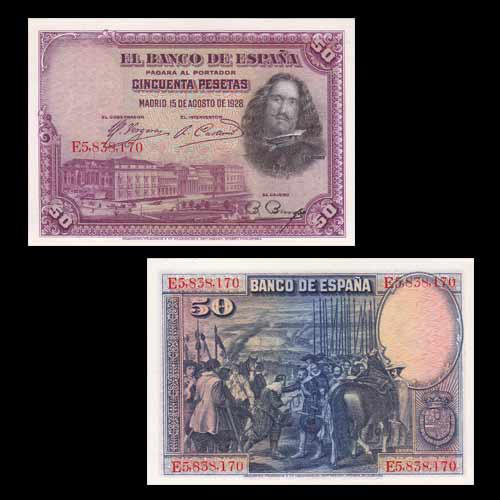
Today let’s look that a Spanish 50 Pesetas banknote of 1928. The obverse of the note depicts the Prado Museum in Madrid (Museo Nacional del Prado). It also sports portrait of Diego Rodriguez de Silva y Velazquez, a leading artist in the court of King Philip IV. He was one of the most important painters of the Spanish Golden Age and was famous for his numerous renditions of scenes of historical and cultural significance.
Now to the historical part:
The reverse has one of the most notable works of Diego Rodriguez: “The Surrender of Breda”, a rendition of a historical event that took place on June 2, 1625! The Surrender of Breda, also known as El Cuadro de las lanzas or Las lanzas was painted by this great individualistic artist of the contemporary Baroque period during the years 1634–35 on canvas.
The Siege of Breda was one of the major successes of Spanish Army in the latter stages of the Eighty Years' War. Breda was a city near the frontier of Holland occupied in 1567 by the Duke of Alba and later seized by Haultepenne. The Spanish general, Genoese aristocrat Ambrogio Spinola, conquered Breda against the instructions of his superiors.
Diego painted ‘The Surrender of Breda’ as an emblem of Spanish nationalism and as a tribute to Ambrogio Spinola. The painting captures the event that took place on June 2, 1625, when the Dutch governor, Justin de Nassau, delivered the keys of the city, symbolically, to Ambrosio de Spinola.
Interestingly, in 1639, shortly after the canvas was completed, Spain lost the city of Breda forever; it was conquered by Frederick Henry of Orange!
It’s amazing how such events can still be retold through our modern currencies. Stay tuned for more of such historical and cultural insights! Till then...keep visiting!
Latest News
-
Bow and Arrow on an Ancient Chera Copper Coin of the Sangam Age
2026-10-09 FriIn our ongoing series exploring the coinage of the Sangam Age, this uninscribed copper coin attri...
-
Symbolic Motifs on an Ancient Chola Copper Coin of the Sangam Age
2026-10-09 FriThe Chola dynasty was one of the three great ruling houses of ancient Tamilakam, alongside the Ch...
-
Iconography of Chera Dynasty on a Square Copper Coin
2026-10-08 ThuThe Cheras were one of the three great crowned dynasties of ancient Tamilakam, alongside the Chol...
-
Decoding the Symbols of a Sangam Age Pandyan Copper Coin
2026-10-08 ThuThe Sangam age is generally placed broadly between c. 300 BCE and 300 CE, although the chronology...
-
Royal Emblems on a Gold Kahavanu of Rajendra Chola
2026-10-07 WedRajendra Chola I (1012–1044 AD) was one of the most powerful rulers of the Chola dynasty and th...