
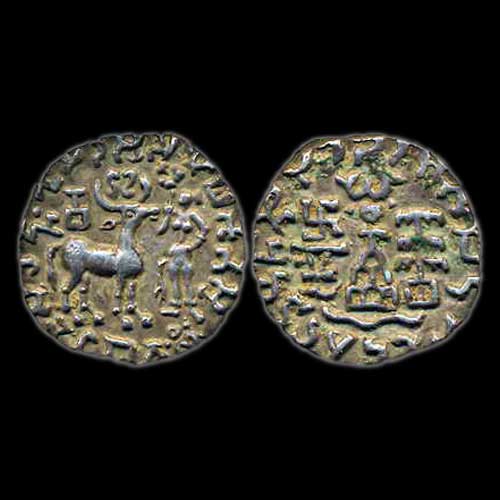
Silver Drachma of Amoghabhuti
2017-10-25 Wed
In 2nd century BCE, there was a native kingdom in the northern region of India called Kuninda stretching along with the foothills of Himalaya. Ptolemy, the Greek historian linked the origin of the Kuninda to the country where rivers like Ganges, Yamuna and Beas (Vyas) originated. The very well known ruler of this kingdom was Amogh also known as Amoghabhuti.Amoghabhuti is known for his beautiful silver and copper coinage. His silver coinage follows the silver standards of Indo-Greek coins. This similarity may suggest the evidence of commercial exchange with its neighbouring kingdoms. Before Amogh’s coinage, the currency circulated in this land was the drachms and tetradrachms of the Indo-Greek rulers.
The above-shown coin is a silver drachm of Amoghbhuti. The obverse of this coin depicts Lakshmi and a deer in the centre surrounded by Brahmi legend ‘Rajno Kunidasa Amoghabhutisa Maharajasa’. The reverse of this coin depicts indradhvaja, swastika, nandipada, a tree in the railing, six arched hill and river below; Kharoshthi legend around.
The design of this coinage was purely native. One of the Edicts of Ashokan pillar of Kalsi in Garwal region indicated the spread of Buddhism in this region which also been seen on Kunindas coins. By the advent of the 3rd century CE, this small Kingdom disappeared from pages of history.
To know more about Kunindas kingdom click here.
Learn more about Kunindas coinage.
Interesting facts
The coins of Kuninda are often found with the coins of Indo-Greek along with Yadheyas and Audumbaras.
Latest News
-
Bow and Arrow on an Ancient Chera Copper Coin of the Sangam Age
2026-10-09 FriIn our ongoing series exploring the coinage of the Sangam Age, this uninscribed copper coin attri...
-
Symbolic Motifs on an Ancient Chola Copper Coin of the Sangam Age
2026-10-09 FriThe Chola dynasty was one of the three great ruling houses of ancient Tamilakam, alongside the Ch...
-
Iconography of Chera Dynasty on a Square Copper Coin
2026-10-08 ThuThe Cheras were one of the three great crowned dynasties of ancient Tamilakam, alongside the Chol...
-
Decoding the Symbols of a Sangam Age Pandyan Copper Coin
2026-10-08 ThuThe Sangam age is generally placed broadly between c. 300 BCE and 300 CE, although the chronology...
-
Royal Emblems on a Gold Kahavanu of Rajendra Chola
2026-10-07 WedRajendra Chola I (1012–1044 AD) was one of the most powerful rulers of the Chola dynasty and th...