
2026-10-16 Fri
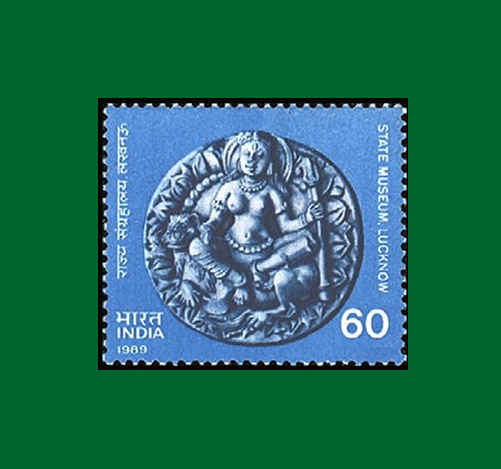
As today marks the sixth day of Navratri, we pay tribute to Goddess Durga, the embodiment of divine feminine power, courage, and protection, through a remarkable Indian postage stamp issued in 1989 to commemorate the 125th anniversary of the Lucknow State Museum. The stamp offers a glimpse into India’s rich artistic heritage by showcasing an exquisite terracotta representation of the goddess, dating back to the Gupta period.
Issued in 1989, the stamp celebrated the 125th anniversary of the Lucknow Museum, one of Uttar Pradesh’s important institutions dedicated to preserving India’s historical, archaeological, and artistic treasures. Among the museum’s significant antiquities is a circular terracotta plaque depicting Goddess Durga seated upon her lion mount, known as Simhavahana. The stamp highlights the enduring relationship between India’s cultural heritage and its philatelic tradition by featuring this ancient artwork.
The terracotta plaque presents Goddess Durga seated in the graceful lalitasana posture. Her lion mount symbolises courage, strength, and the triumph of righteousness over evil. The composition reflects the artistic sensibilities of the Gupta period, often regarded as a golden age of Indian art and culture.
The goddess’s figure is characterised by smooth, rounded contours and an elegant simplicity reminiscent of the classical artistic traditions associated with Sarnath and other North Indian centres. Rather than relying on elaborate ornamentation, the sculptor conveys her divine presence through balanced proportions, serene features, and carefully rendered details.
Durga’s jewellery further accentuates her regal and sacred status. She wears a broad collar necklace, known as a graiveyaka, along with large circular earrings or kundalas. Her heavy waistbands and armlets contribute to the visual richness of the composition. Her hair is arranged in a voluminous, coiled crown-like formation called a jatamukuta, combining associations of ascetic discipline with divine authority.
In her left hand, the goddess holds a long, vertically positioned shaft, interpreted as a trident (trishula) or possibly a ceremonial lance. This attribute reinforces her association with divine protection and the destruction of evil. The two-armed representation, framed within a circular medallion featuring a lotus-petal design, demonstrates how Gupta-period artists could convey religious symbolism through a restrained yet expressive visual language.
The 1989 commemorative stamp serves as more than a tribute to the Lucknow Museum’s milestone anniversary. It brings an important example of ancient Indian religious art into the world of philately, preserving its image for collectors and admirers of cultural heritage.
On the sixth day of Navratri, this depiction of Goddess Durga reminds us of the timeless significance of Shakti—the divine feminine energy that sustains, protects, and empowers. Through this stamp, India’s ancient artistic traditions continue to inspire devotion and appreciation across generations.
-
Celebrating the Spirit of Durga Puja through a Child’s Art Stamp
2026-10-16 FriWith Navratri celebrations in full swing, it is the perfect time to look back at a wonderfully vi...
-
Goddess Kali on a Nagapattinam Copper Stuiver Coin
2026-10-15 ThuIn the spirit of Navratri, a copper coin from Nagapattinam bearing the facing figure of Goddess K...
-
Shiva and Parvati on a Gold Varaha of Devaraya I, Vijayanagara Empire
2026-10-15 ThuNavratri celebrates the many manifestations of the Divine Feminine, or Shakti, representing the p...
-
Celebrating Navratri through Numismatics: Gold Pagoda of the Kadambas of Hangal
2026-10-14 WedThe coinage of medieval Karnataka offers fascinating insights into the political authority, artis...
-
Kubera, God of Wealth, on a Rare Dramma of the Early Rashtrakutas
2026-10-14 WedThe coinage of medieval Maharashtra offers fascinating glimpses into the region’s political his...