
2026-10-07 Wed
The Venad Cheras formed an important branch of the medieval Chera tradition in the southern part of the Indian peninsula. Venad, centred in the region of present-day southern Kerala and extending at various times into adjoining areas of Tamil Nadu, emerged as a significant political power after the decline of the later Chera Perumal kingdom. Its rulers maintained close political and cultural connections with the Tamil country, and their coinage reflects the interaction of Chera, Chola and Pandya traditions.
The history of Venad is closely connected with the changing political landscape of southern Tamilakam. During the medieval period, territories in and around the Tirunelveli region witnessed competition and interaction between the Pandyas, Cholas and Venad Cheras. Numismatic evidence is particularly valuable for understanding this period because many Venad issues do not carry explicit royal names. Instead, they employ distinctive symbols, figures and letters that help identify their association with the Venad Cheras.
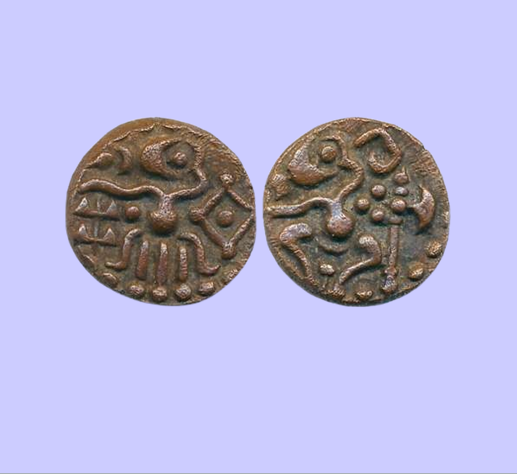
Among these are the celebrated Parasu, or battle-axe, types. The battle axe is an important symbol in Venad Chera coinage and has been associated by numismatists with Parasurama, the legendary figure traditionally connected with the creation of Kerala. The letter appearing above the axe has also been interpreted as the Grantha “Ra”, rather than simply a Tamil letter, adding another layer of religious and cultural symbolism to these coins.
The coin under discussion is a copper issue weighing 4.06 grams. The obverse features a standing figure, flanked on either side by a lamp and chakra. The reverse presents a seated figure, accompanied by several pellets. To the side appears a parasu, or battle axe, with the Grantha “Ra” above it. The standing-figure motif is characteristic of a wider South Indian numismatic tradition that developed from Chola-period coin designs.
The lamp is an auspicious and religious symbol; whiles the chakra or wheel, carries strong religious associations. Together with the standing figure, these elements create a design that combines royal and sacred imagery.
The battle axe is the most distinctive element of this type. In studies of Venad coinage, the parasu has been linked with Parasurama, an important figure in the traditional history of Kerala. The association is particularly compelling because the axe appears together with the letter identified by some scholars as the Grantha Ra, possibly referring to Rama or Parasurama.
The design of this coin also demonstrates the strong Chola influence on Venad coinage. The standing and seated figures belong to a South Indian numismatic tradition that can be traced through Chola, Pandya and Sri Lankan issues. This combination makes Venad coinage particularly interesting. Rather than simply copying Chola or Pandya money, the Venad Cheras appear to have incorporated established regional conventions into a distinct visual language of their own.
-
Royal Emblems on a Gold Kahavanu of Rajendra Chola
2026-10-07 WedRajendra Chola I (1012–1044 AD) was one of the most powerful rulers of the Chola dynasty and th...
-
Elephant and Lion/Tiger on a Rare Copper Coin of the Sangam Cholas
2026-10-06 TueThe Cholas were one of the three great Tamil dynasties of the Sangam age, alongside the Cheras an...
-
Pandya Dhananjaya Gold Gadyana of the Alupas of Alvakheda
2026-10-06 TueThe Alupas, also known as the Alupa dynasty, were an important ruling house of the coastal Karnat...
-
With 85 Medals, India marks a Historic Chapter in ASIAD
2026-10-05 MonIndia concluded its campaign at the Aichi-Nagoya Asian Games 2026 with an impressive 85...
-
India’s Kabaddi Golden Double at Asian Games 2026
2026-10-05 MonIndia continued its remarkable dominance in kabaddi at the Asian Games, winning two gol...