
2026-09-16 Wed
The elephant has held a prominent place in India’s cultural heritage for centuries, symbolising strength, wisdom, prosperity and royal power. Its enduring presence in Indian art, literature, religion and coinage reflects the deep cultural significance attached to this majestic animal.
The Satavahanas were one of the most important early historic dynasties of the Deccan, ruling over extensive territories in central and southern India from around the late 2nd century BCE to the early 3rd century CE. Satavahana coins are particularly notable for their distinctive symbols, legends in Brahmi script and representations of animals and deities.
Siri Satakarni (Satakarni I), an early Satavahana king of the mid-to-late 1st century BCE, expanded the dynasty by conquering western Malwa from the Shungas plus Anupa and Vidarbha. He assumed titles such as Dakshinapathapati and Apratihatacakra. As per the Naneghat inscription of queen Naganika, he performed two Ashvamedha sacrifices and a Rajasuya along with other Vedic rites while facing limited pressure from Kalinga’s Kharavela. His early coinage, mainly lead, potin and copper, typically shows an elephant with the Ujjain symbol or river-and-fish motif and Brahmi legends like “Rano Siri Satakanisa,” circulating in the western Deccan and Malwa as markers of royal authority before later portrait issues.
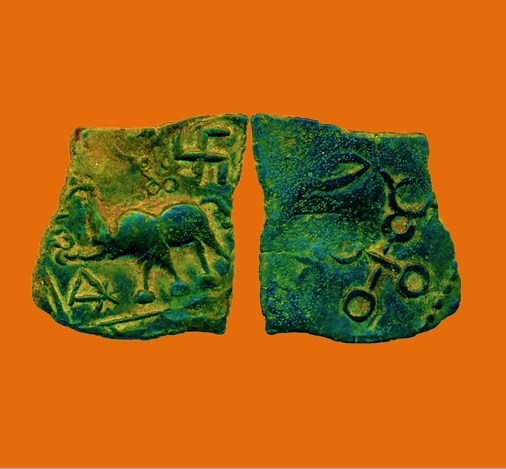
Here, the coin weighs 6.08 g and is notable for being overstruck on an earlier coin, a feature that offers an intriguing glimpse into the circulation and adaptation of coinage in ancient India.
The obverse depicts an elephant standing facing left with its trunk raised. Above the elephant is a swastika, while the Srivatsa symbol appears in front. A Brahmi legend runs around the design, identifying the ruler. The reverse features a deity, accompanied by the distinctive Ujjain symbol. The Ujjain symbol, generally represented by a cross with four circles at its ends, occurs widely on ancient Indian coins and is especially associated with the monetary traditions of the Malwa region.
-
Caparisoned Elephant on Gangas of Talakadu Gold Coin
2026-09-16 Wed -
Rare “Ganapati–Pantapradhan” Rupee of Patwardhans of Miraj
2026-09-15 Tue -
Ganesha on a Nayaka Copper Coin
2026-09-15 Tue -
Gold Gadyana of Manuma Siddhi III, Telugu Cholas
2026-09-09 Wed -
Rare Copper Coinage of the Kakatiyas King Prataparudra II
2026-09-09 Wed