
2026-09-09 Wed
The Kakatiyas were one of the most important medieval dynasties of the eastern Deccan, ruling large parts of present-day Telangana and adjoining regions between the 12th and early 14th centuries. They initially served as feudatories of the Western Chalukyas of Kalyani before gradually asserting their independence. Hanamkonda was an important early capital, while Warangal, also known as Orugallu, became the principal royal centre under Ganapatideva.
The Kakatiyas are remembered not only for their political and military achievements but also for their contributions to architecture, irrigation and temple construction. The Thousand Pillar Temple at Hanamkonda and the Ramappa Temple are among the most celebrated monuments associated with their period.
The dynasty reached its final phase under Prataparudra II, whose reign ended with the fall of Warangal to the forces of the Delhi Sultanate in 1323 CE. He was the last sovereign of the Kakatiya dynasty. He succeeded his grandmother, Rudramadevi, and ruled from the late 13th century until the collapse of Kakatiya power in 1323 CE.
In the early part of his reign, Prataparudra worked to restore Kakatiya authority over chiefs who had asserted their independence during the later years of Rudramadevi's rule. He also campaigned against neighbouring powers and strengthened Kakatiya control over parts of the eastern and southern Deccan.
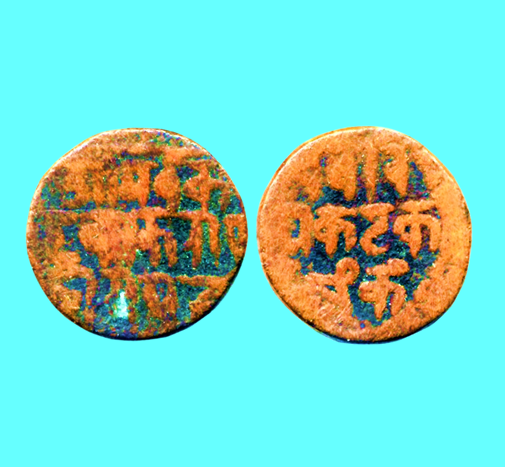
Prataparudra is also of considerable importance in the history of Indian coinage. Among the rarest issues attributed to him are copper coins bearing legends in Devanagari script, providing an important numismatic link to the final phase of Kakatiya rule.
Here, the coin is a rare copper issue of Prataparudra II. It weighs 9.31 grams. The obverse of the coin depicts, Devanagari legend, “Shri Madhuka / ra Kakatiya / Pratapa(rudra).” The reverse carries the legend which continues to obverse, “Deva Vi / jaya Kataka / 2 Anka”. The coin is particularly significant because it provides evidence of copper currency during the closing years of Kakatiya rule.
-
Gold Gadyana of Manuma Siddhi III, Telugu Cholas
2026-09-09 Wed -
A Rare Silver Tanka of the Dimasa Kings of Megha Narayana of Kachar
2026-09-08 Tue -
Silver Rupee of Chaurajit Simha, Manipur
2026-09-08 Tue -
The Winged Bull on a Licchhavi Coin of King Jishnu Gupta
2026-09-07 Mon -
Copper Paisa of Thutob Namgyal, Sikkim
2026-09-07 Mon