
2026-09-02 Wed
The Yadavas of Devagiri, also known as the Seuna Yadavas, were among the most important medieval dynasties of the Deccan. With their capital at Devagiri, the dynasty developed into a major political power in western and central India. The Yadava kingdom reached a high point during the 13th century, when rulers such as Singhana II and his successors expanded their influence across large parts of the Deccan.
Mahadeva (c. 1261–1270 CE) was a later ruler of this powerful dynasty. His reign is particularly interesting to numismatists because of the distinctive gold coinage attributed to him.
The term “punch-marked” describes a method of coin production in which individual symbols, letters, or emblems were impressed onto a previously prepared metal flan using separate punches.
The famous silver punch-marked coins of the early historic period demonstrate that individual punches were being used to place multiple symbols on a single piece of metal centuries before the Yadavas. The Yadava gold Padma Tanka represents a much later and highly distinctive continuation of the concept, adapted to the monetary and artistic traditions of medieval Karnataka and the Deccan.
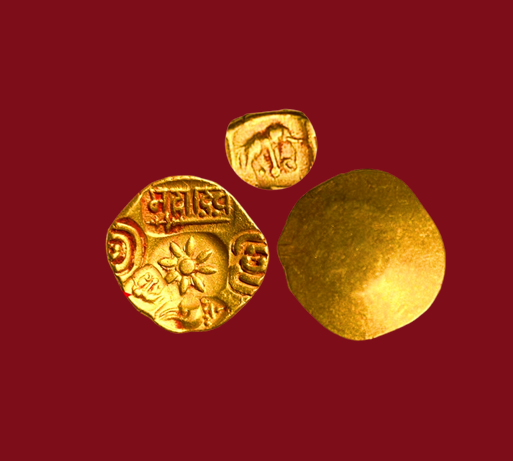
Mahadeva Padma Tanka are known with five or six punches, making these coins particularly fascinating examples of medieval Indian punch-marked gold coinage.
Here the coin is a Gold Gadyana–Padma Tanka of Mahadeva, weighing 3.81 grams. It is a uniface, punch-marked coin, with the design concentrated on one side while the reverse remains blank. Due to the punch marked technique, it has a concave shape.
The coin carries six separate punches:
• Two punches bearing the Kannada letter “Shri”
• One Shankha (conch shell)
• A lotus (Padma) at the centre
• An elephant
• A Devanagari legend reading “Mahadeva”, accompanied by a Khanda sword below
The name Padma Tanka derives from the prominent padma, or lotus, which occupies the central position in this coin type. The lotus was one of the most enduring symbols of Indian religious and artistic tradition.
In Hindu symbolism, the lotus is associated with purity, auspiciousness, prosperity, divine beauty, and spiritual transcendence. Its ability to rise above muddy water while remaining visually pure made it a powerful metaphor for purity and sacredness.
The padma also had a strong connection with Lakshmi, the goddess of prosperity and abundance. As a result, the padma became an auspicious symbol particularly appropriate for coinage.
The Shankha, or conch shell, is another important Hindu symbol. Strongly associated with Vishnu, it represents auspiciousness, divine authority and the proclamation of sacred power. Its presence alongside the lotus adds another layer of religious symbolism to the coin.
The elephant carries several possible associations in Indian visual culture, including royal power, strength, prosperity, and auspiciousness. Its appearance as an additional punch on this Mahadeva variety makes the coin particularly distinctive. Contemporary catalogue descriptions specifically identify this elephant punch as an unusual feature of the type.
-
Lion on Silver Coin of Devgiri Yadava King Singhana Deva II
2026-09-02 Wed -
Coin of the Last Chauhan of Ranthambhor, Hammira Deva
2026-09-01 Tue -
Silver Dramma of the Chauhans Jaitra Simha of Ranthambhor
2026-09-01 Tue -
Silver Rupee from Tibet
2026-08-31 Mon -
Divine Shiva & Parvati on a Tanjore Maratha Copper Mudra
2026-08-31 Mon