
2026-09-01 Tue
The history of Ranthambhor reached its dramatic climax under Hammira Deva, one of the most celebrated rulers of the dynasty. He ruled Ranthambhor in the late 13th and early 14th centuries and is remembered for his resistance to the expanding power of the Khalji dynasty of Delhi. Hammira inherited a strategically important kingdom centred on the powerful Ranthambhor Fort.
During his reign, the fortress became a major centre of resistance against the Delhi Sultanate. His refusal to submit to Alauddin Khalji ultimately led to a prolonged conflict. In 1301, Alauddin Khalji's forces captured Ranthambhor after a siege aided by Hammira's betrayers, bringing the independent Chauhan kingdom of Ranthambhor to an end for a short time. Hammira's resistance subsequently became an enduring theme in Rajput historical and literary traditions.
You can also read more about the Silver Dramma of the Chauhans Jaitra Simha of Ranthambhor
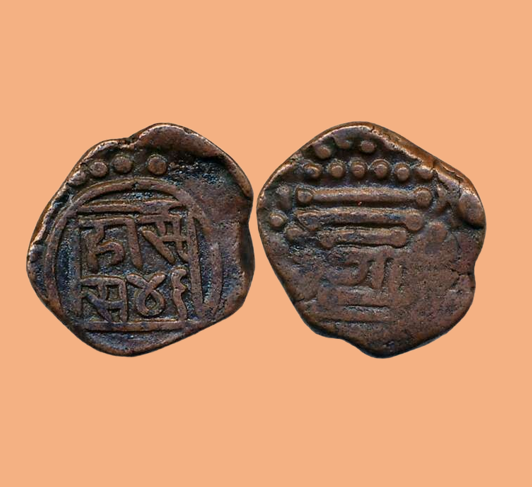
Hammira Deva’s coinage provides a fascinating glimpse into the monetary traditions of the Ranthambhor Chauhans. One such example is shared herewith, copper Drachm weighing 3.75 grams, classified as an “Indo-Sassanian” type.
The obverse presents a distinctive arrangement: within a dotted circle is a rectangular panel bearing the Devanagari inscription “Ha Pri Sa 46.” The compact legend and highly stylized design reflect the transformation of earlier Indo-Sasanian coin types in the hands of regional medieval Indian dynasties.
The reverse depicts a stylized representation of a fire altar, a motif characteristic of the numismatic continuity of Indo-Sasanian coinage of northern and western India. Such designs had their origins in earlier monetary traditions and continued for a prolonged time.
This 3.75-gram copper Drachm of Hammira Deva is not merely a small denomination of medieval currency. Its fire-altar motif, Devanagari inscription and attribution to the Chauhan ruler bring together several centuries of Indian numismatic tradition. It also evokes the final chapter of Chauhan sovereignty at Ranthambhor, where Hammira Deva's resistance against Alauddin Khalji transformed him into one of the most remembered figures in the medieval history of Rajasthan.
19 Years later, Ranasthambhapur aka Ranathambhore was captured by a Mewar King of same name Rana Hammir Singh! And, after 150 years, it passed to Hada Chauhans
-
Silver Dramma of the Chauhans Jaitra Simha of Ranthambhor
2026-09-01 Tue -
Silver Rupee from Tibet
2026-08-31 Mon -
Divine Shiva & Parvati on a Tanjore Maratha Copper Mudra
2026-08-31 Mon -
Baroda Last Ruling Maharaja Pratap Singh Gaekwad’s Rare Mohur
2026-08-29 Sat -
Shiva-Parvati in Gold: The Sacred Varaha of Krishna Raja Wodeyar III
2026-08-29 Sat