
2026-09-01 Tue
The Chauhans of Ranthambhor were a 13th-century Rajput dynasty that ruled from the formidable hill fort of Ranthambore in present-day Rajasthan. They were a collateral branch of the famous Chauhans of Shakambhari (Ajmer). After the decline of the main Chauhan kingdom centered at Ajmer and Delhi, the Ranthambhor branch continued to assert its independence from its formidable hill fortress.
Ranthambhor, strategically located in present-day Rajasthan, was one of the most important strongholds of medieval northern India. Its formidable fort commanded routes connecting northern India with the Malwa and Gujarat regions, making the territory strategically significant. The Chauhan rulers of Ranthambhor maintained their authority from this stronghold during a period marked by intense political competition among Rajput states and the expanding Delhi Sultanate.
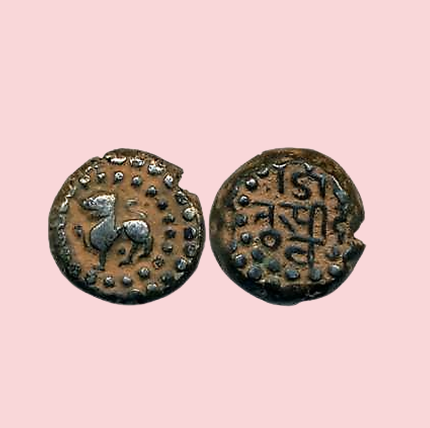
The Chauhans of Ranthambhor issued a modest but distinctive coinage in the late 13th century, mainly silver drammas (also called drachms) and copper pieces. The coinage pattern reflects a regional Rajput style; lion as a symbol of royal power.
Among the notable rulers of the Ranthambhor Chauhans was Jaitra Simha, who ruled during the 13th century. He inherited a kingdom situated in a politically challenging environment and worked to preserve Chauhan authority around Ranthambhor. His reign falls within a period when the Chauhans of Ranthambhor were increasingly confronted by the expanding power of the Delhi Sultanate.
Jaitra Simha's coinage provides an important numismatic record of his rule. His coins retained the characteristic lion motif, a powerful symbol associated with royal strength and authority. The use of the lion on the coinage also gives these issues a distinctive connection with the martial identity of the Chauhan rulers.
Here, the silver Dramma of Jaitra Simha, weighing 4.31 grams. On its obverse, a lion faces left, its powerful form occupying the principal field of the coin. The reverse carries the Devanagari legend “Jaitasi Deva”, identifying the issuing ruler.
The legend is particularly significant because it provides a direct link between the coin and its royal issuer. At a time when coins frequently conveyed political authority through symbols and legends, the combination of the lion and the ruler's name created a compact statement of sovereignty.
This silver Dramma therefore represents more than a medium of exchange. It is a tangible reminder of the Chauhans of Ranthambhor, their royal traditions and their struggle to preserve their political identity in medieval Rajasthan. Through its lion emblem and the legend “Jaitasi Deva,” the coin connects the legacy of Jaitra Simha with one of the most dramatic chapters in the history of Ranthambhor.
-
Coin of the Last Chauhan of Ranthambhor, Hammira Deva
2026-09-01 Tue -
Silver Rupee from Tibet
2026-08-31 Mon -
Divine Shiva & Parvati on a Tanjore Maratha Copper Mudra
2026-08-31 Mon -
Baroda Last Ruling Maharaja Pratap Singh Gaekwad’s Rare Mohur
2026-08-29 Sat -
Shiva-Parvati in Gold: The Sacred Varaha of Krishna Raja Wodeyar III
2026-08-29 Sat